Showing posts with label RAND. Show all posts

Thursday, 18 February 2016

Equilibrium Warfare in Syria - U.S. using ISIS as the sectarian spearhead and Russia as the equalizer

In 2015 a document by the U.S. Department of Intelligence (DIA) was leaked with some astonishing details that were not redacted. You don't want to go away without knowing this!

It starts off with the general situation in Iraq and Syria and explains that they are both heading in the sectarian direction, failing to mention this to be a negative aspect of the war. We will conclude at the end of this article whether or not the U.S. seek a sectarian war or not.



Interestingly, this report was drafted in 2012 and released in 2015, way before Russia's involvement in the Syrian crises. At the time of Russia's involvement we heard many American diplomats and opposition politicians bombarding the media with this narrative that Russia are stealing America's thunder and Obama is incapable in his policies in Syria. A lot of people saw this role of Russia in Syria contrary to what America wanted and this narrative is still played out today. The report actually documents that Russia will be involved in this conflict and will side with the Assad regime - they knew this from the very beginning it was planned, drafted and agreed upon.



You can clearly read from that, that the U.S. require an equilibrium in Syria and from the very onset they knew that the Russians were only there to kill off the opposition that the West, Gulf and Turkey have been supporting to maintain an equal playing ground. If the U.S. sought to resolve the Syrian crises then surely it would solve its issues with Russia, China and Iran to stop them from supporting the regime, right?

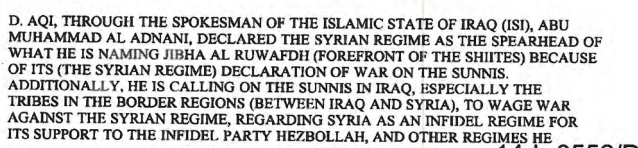
Who are the opposition you ask? Well from the media we know that the West are supporting the Free Syrian Army and anyone linked to the Syrian National Coalition however it clearly denotes in this document that without the work of AQI (now known as ISIS), they could not play a pivotal role in uniting the Sunni Muslims under the sectarian card to fight the dissenters who they call the Jibha al-Ruwafidh (Forefront of the Shiites)


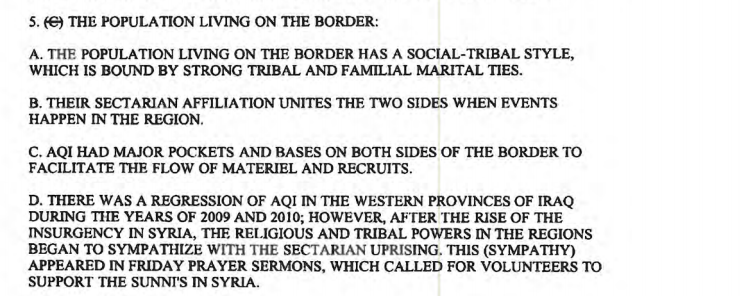
It goes on to say that the flow of fighters and ammunition comes through the border between Iraq/Syria and it depends on AQI (now ISIS) as it has major pockets and bases on both sides. This spells out that without ISIS, the West could not support the opposition against Assad or keep the equilibrium going to destroy the infrastructure, people and livelihoods of Syria and Iraq.


It mentions that the future holds a safe haven for the Syrian regime, i.e. Assad and the Alawi's. This is reaffirmed by the recent plans drawn up by RAND and the Brookings Institute explaining the greater plan for a federalized Syria into three regions.



Now the key for the next point is in the wording. The U.S. have maintained that they want a peaceful solution to the Syrian crises and they'll take every opportunity to demean Russia's actions in Syria, but make a note of the wording on this next point in the document.
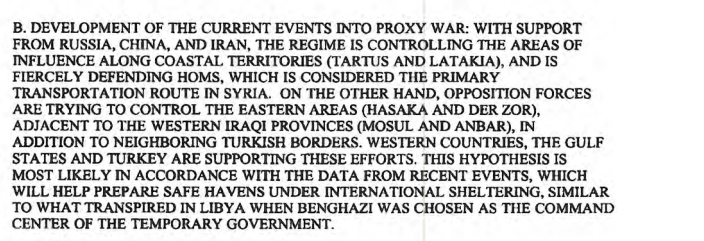


Did you spot it?

Try again....


That's right the development of a proxy war WITH SUPPORT from Russia, China and Iran. This proxy war is undoubtedly and undeniably a proxy war that doesn't see the Americans, Russians, Chinese or even Europeans losing their lives. It is the MUSLIMS who are being targeted and it is the Muslims who are losing their lives for a war that is not even their own.

The report finally goes onto 'prophesies' if I may use that term loosely, that the opposition which the West support will use Iraq as a launch pad and safe haven for the Salafists, i.e. ISIS - whom they fully support and whom without the equilibrium could not be sustained without marring their own faces and sending in their own troops as was the case in the Iraq war.

And just to top all of this off they kindly mention that 'if the situation unravels' in the West's favour there is a 'possibility of establishing a declared or undeclared salafist principality' - and what is the form of interpretation of Islam ISIS are following? ... how convenient.. it's Salafist.



Finally it decides to redact the part about facilitating the terrorist organisations into entering the Iraqi arena.
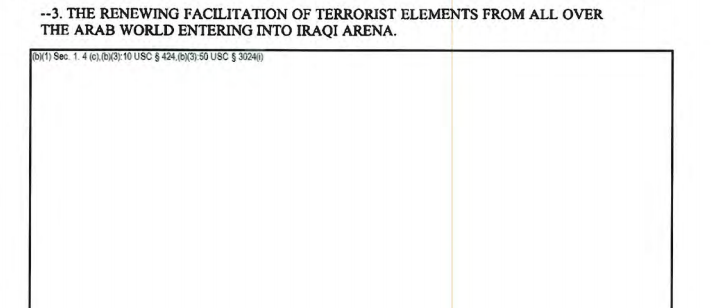


If this section were to take the angle that other powers out of America's control were facilitating the terrorist elements to enter the Iraqi arena then it surely wouldn't have redacted this part out. It leads one to believe that this section was in fact talking about how the West can renew the facilitation of rounding up the Jihadi organisations from around the world and push them into Iraq. Exactly what ISIS are doing today with many groups pledging their allegiances to them and flocking to join their ranks.

Now if you still believe ISIS are not their to serve the agenda of the West, then you're truly and utterly naive. This is a sectarian war headed by the U.S with its allies Russia, Iran and China to bring the Muslims to their knees and destroy whatever they have left in their capability, i.e. nuclear, manpower or resources and ultimately their religion that binds them.

Thank you for reading this, share this widely with others.

Jazakamullah Khairan

Monday, 11 January 2016

Three paths for the U.S to maintain its hegemony on the world including another 9/11 attack?

RAND, a leading political and security think-tank in America, have recently published a report, third in its series titled 'Friend, Foes and Future Directions: U.S. Partnerships in a Turbulent World, Strategic Rethink'

It states that the U.S. have three stances that it can take in the coming year(s).

To mitigate this mismatch, U.S. policymakers have at least three general approaches to consider:
  • First, the United States could take an assertive approach focused primarily on American values, thereby limiting compromise with potential adversaries. Washington would seek a few capable partners but would be prepared to go it alone or with a small coalition of the willing if needed. This “assertive engagement” option would require a significant increase in defense spending. 
  • Second, the United States could seek greater defense contributions from allies and partners. Under such a policy, termed “collaborative engagement,” the United States would act based primarily on its interests and would seek to further harmonize its policies more with its major allies and strategic partners. It would be more dependent on the will of its partners and would be inclined to seek some accommodation, where possible, with potential adversaries. It would be more restrained in its policy choices and stress regional trade partnerships.
  • Third, the United States could reduce its ambitions and focus on only the most critical challenges to its own vital national interests. In some cases, it might need to reduce its commitments to partners. It would stress homeland resilience and seek to find surrogates to take the lead wherever possible. This alternative is called “retrenchment.”
 It is important to note what the term allies and partners means. The Washington Institute would write in a recent article that:

Saudi Arabia and the United States have been partners -- not allies. Typically, America's allies share values and not just interests.

United States view partners as those who do not share the same values and ideals however share common interests, such as Saudi Arabia and Iran. However a partner are those who share the values and ideals such as freedoms and democracy. This includes the likes of Great Britain, France and Germany.

The report goes on to suggest that if the U.S. were to take the first path it would require a massive amount of economic support and such support would not be possible without the American public and therefore only a stunt such as 9/11 could sway public opinion in agreement.

One U.S. election is unlikely to fundamentally change those constraints. It would probably take another direct attack on the homeland, like 9/11, to shift both public opinion and spending priorities enough to finance this approach.
However it is quite clear that the second pathway is preferred under the Obama administration, making use of its partners in the region such as Iran and Saudi.

Thursday, 24 December 2015

What does it mean to be a Revisionist State?

I've always struggled to explain the term revisionist or revisionism until I came across this publication by RAND. It's titled "Mastering the Gray Zone: Understanding a Changing Era of Conflict".

I'm not going to discuss this publication as I've not yet had a chance to fully read it, however it summarises for me the term revisionist quite accurately and therefore I'd like to share this with you also.

The author starts off  explaining China's gradual and revisionist approach towards dominating the regions near to them.

In the remote reaches of the South China Sea in the Spratly Island chain, China is creating land. In order to bolster its claims to the waters of the region, Beijing is pouring millions of metric tons of sand and concrete onto submerged reefs, creating artificial islands.1 Island-building is merely one of the most obvious of many actions, ranging from propaganda to economic coercion and swarming fleets of fishing vessels, that China has been taking to solidify its assertion of territorial and resource rights throughout the region. Step by forceful step, China is laying the groundwork for a new order in the region that recognizes Beijing’s unquestioned primacy, and for an international system whose norms and institutions reflect China’s interests and preferences.

“China is biding its time,” one report recently concluded, “slowly eroding American credibility in the region, changing facts on the ground where it believes it can and carefully calibrating the coercion of its rivals in the South China Sea.”
The example of China is fitting for a revisionist state extending its reach into places it really has no authority due to the hand of the superpower that has it's fingers clenched into the soil across the entire globe.

Here the author explains revisionism  
This series of actions is a powerful example of an approach being used by more and more states with partial, but still obvious, revisionist intent—that is to say, states dissatisfied with the status quo and determined to change important aspects of the global distribution of power and influence in their favor. Unwilling to risk major escalation with outright military adventurism, these actors are employing sequences of gradual steps to secure strategic leverage. The efforts remain below thresholds that would generate a powerful U.S. or international response, but nonetheless are forceful and deliberate, calculated to gain measurable traction over time. In one important sense, they are classic “salami-slicing” strategies, fortified with a range of emerging gray area or unconventional techniques—from cyberattacks to information campaigns to energy diplomacy. They maneuver in the ambiguous no-man’s-land between peace and war, reflecting the sort of aggressive, persistent, determined campaigns characteristic of warfare but without the overt use of military force.


Wednesday, 23 December 2015

The Key Policy Making Reports and Articles of the 21st Century


In this post I have amalgamated all the key policy making documents that I feel are game changing for the Ummah in 2015. These are all a must read for all Muslims, to be aware of the plots and plans of the West.


The Redirection by Seymour Hersh
An article cited by many freelance journalists to be bluntly true about America's redirection in the Middle East.

From Pol Pot to ISIS: "Anything that flies on everything that moves"
Interesting article that is packed with quotes from previous officials within the U.S regarding the Iraq war.

Burma Campaign UK
A 2006 36-page document out of the "Burma Campaign UK" explicitly details the enormous amount of money and resources both the US government and its corporate-funded foundations have poured into Suu Kyi's image and her "movement."

Al Qaeda's Foreign Fighters in Iraq
In November 2007, the Combating Terrorism Center at West Point received nearly 700 records of foreign nationals that entered Iraq between August 2006 and August 2007. The data compiled and analyzed in this report is drawn from these personnel records, which was collected by al‐Qa’ida’s Iraqi affiliates, first the Mujahidin Shura Council (MSC) and then the Islamic State of Iraq (ISI). The records contain varying levels of information on each fighter, but often include the fighter’s country of origin, hometown, age, occupation, the name of the fighter’s recruiter, and even the route the fighter took to Iraq. The records were captured by coalition forces in October 2007 in a raid near Sinjar, along Iraq’s Syrian border. Although there is some ambiguity in the data, it is likely that all of the fighters listed in the Sinjar Records crossed into Iraq from Syria. The Sinjar Records’ existence was first reported by The New York Times’ Richard Oppel, who was provided a partial summary of the data. English translations of the Records can be accessed at
and the records in their original Arabic text at:

However I think these original documents have now been removed, the summary is still available at:


Choices for America in a Turbulent World by RAND
A magazine by RAND featuring many interesting articles which include counterterrorism, picking partners and identifying enemies, rebalancing civil liberties and security, the arab-israeli settlement, learning lessons from the past and US National Strategy.

Saving Syria: Assessing Options for Regime Change by Brookings Institute
This memo lays out six options for the United States to consider to achieve Asad’s overthrow, should it choose to do so:
  1. Removing the regime via diplomacy; 
  2. Coercing the regime via sanctions and diplomatic isolation;
  3. Arming the Syrian opposition to overthrow the regime;
  4. Engaging in a Libya-like air campaign to help an opposition army gain victory;
  5. Invading Syria with U.S.-led forces and toppling the regime directly; and
  6. Participating in a multilateral, NATO-led effort to oust Asad and rebuild Syria.
http://www.brookings.edu/~/media/research/files/papers/2012/3/15-syria-saban/0315_syria_saban.pdf

Deconstructing Syria: Towards a regionalized strategy for a confederal country by Brookings Institute
This paper makes a case for a new approach to Syria that attempts to bring ends and means more realistically into balance. It also seeks to end the Hobson’s choice currently confronting American policymakers, whereby they can neither attempt to unseat President Assad in any concerted way (because doing so would clear the path for ISIL), nor tolerate him as a future leader of the country (because of the abominations he has committed, and because any such policy would bring the United States into direct disagreement with almost all of its regional allies). The new approach would seek to break the problem down in a number of localized components of the country, pursuing regional stopgap solutions while envisioning ultimately a more confederal Syria made up of autonomous zones rather than being ruled by a strong central government. It also proposes a path to an intensified train and equip program. Once that program had generated a critical mass of fighters in training locations abroad, it would move to a next stage. Coupled with a U.S. willingness, in collaboration with regional partners, to help defend local safe areas using American airpower as well as special forces support once circumstances are conducive, the Syrian opposition fighters would then establish safe zones in Syria that they would seek to expand and solidify. The safe zones would also be used to accelerate recruiting and training of additional opposition fighters who could live in, and help protect, their communities while going through basic training. They would, in addition, be locations where humanitarian relief could be provided to needy populations, and local governance structures developed.

A Peace Plan for Syria by RAND
An important policy making document on advising America on which way to turn in Syria and which path to ultimately take. The two paths it discusses are:
  1.  To concentrate on brokering a comprehensive political arrangement among the warring Syrian parties and their external sponsors, including the reform of state institutions, the formation of a new government, and a plan for elections, accompanied by a ceasefire and the beginning of a process of reconstruction.
  2. To secure agreement to an immediate ceasefire, which would be followed by further negotiations on the shape of a reconstituted Syrian state and government.
It advises the White House to take the second path into regionalising Syria into three safe zones, i.e. Alawi/Assad region, Kurds Region, Opposition/Rebel region. The rest of Syria will then be deemed to be ISIS held and targeted for mass killings by all three regions cooperatively including the international arena.

2016 Global Forecast by Centre for Strategic & International Studies 
An important lessons learned forecast by CSIS who are a liberal leaning Washington think tank. It gives an insight into the frustrations of America and forecasts the future.

Rethinking Political Islam by Brookings Institute
Rethinking Political Islam is the first project of its kind to systematically assess the evolution of mainstream Islamist groups across 12 country cases—Egypt, Tunisia, Morocco, Syria, Yemen, Libya, Saudi Arabia, Kuwait, Jordan, and Pakistan, as well as Malaysia and Indonesia. The project engages scholars of political Islam through in-depth research and dialogue to consider how the Arab uprisings and their aftermath have shaped—and in some cases altered—the strategies, agendas, and self-conception of Islamist movements.


RAND's peace plan for Syria

RAND Report: http://www.rand.org/content/dam/rand/pubs/perspectives/PE100/PE182/RAND_PE182.pdf

It is important to know that the RAND corporation are no ordinary think-tank. They are one of the leading think-tanks in America that have shaped policy and decision making at the highest level. This is why any analysis that come out of RAND, you can be sure that it is the direction the politicians will take in America.

This recent report by RAND regarding the peace plan for Syria agrees with much of the Brooking's Institutions report on deconstructing Syria towards a regionalized strategy.

The report starts off by recognising the two paths that can be taken in Syria, them being:

  1. Concentrate on brokering a comprehensive political arrangement among the warring Syrian parties and their external sponsors, including the reform of state institutions, the formation of a new government, and a plan for elections, accompanied by a ceasefire and the beginning of a process of reconstruction.
  2. The second approach would be to secure agreement to an immediate ceasefire, which would be followed by further negotiations on the shape of a reconstituted Syrian state and government.

We can see that the West are currently aiming for the first path by gathering the opposition to come to an agreement. However whether or not Assad stays or leaves is the main sticking point for most of the warring factions - something that Russia also wish to have a say in. 

RAND suggest that path one is unrealistic now that sectarianism is as rife as ever. 
"pitting the regime against the opposition, Shi’a against Sunni, Arab against Kurd, and moderate against extremist. It has attracted tens of thousands of foreign fighters from Europe, North America, and Africa; exacerbated geopolitical rivalries among Saudi Arabia, Iran, Russia, the United States, and others; and drawn in the armed forces of nearly a dozen external states. There may have been a time, early on, when it could be argued that the benefits of overthrowing Assad would be worth the human, strategic, political, and economic costs of achieving that goal, but that time has long past. At this point, whether President Assad stays or goes in the near term should be regarded as a matter of pure expediency"

Whereas the second path seems to be more achievable according to both RAND and the Brooking's Institute. The most telling point of this report is the acknowledgement of three safe zones for Syria. RAND writes:

"Were the fighting to be halted on the basis of the territory currently held, Syria would find itself divided into roughly four zones—one controlled by the government; one controlled by the Kurds; one controlled by diverse elements of the Sunni opposition; and one controlled largely by the Islamic State of Iraq and Syria (ISIS).1 As ISIS has no foreign sponsors, is largely immune to external influence, and is certain to reject any ceasefire, Syria would effectively be divided into three “safe” zones in which the parties agreed to stop fighting, and one zone in which all other parties would be free to wage war on ISIS."

 RAND's proposal acknowledges three difficult realities.

  1. The first is that four years of fighting and more than a quarter million dead have left Syria intensely divided by sect and ethnicity. It should be a goal to mitigate those divisions in the long run, but they must be acknowledged in the short run.
  2. Second, ousting the current regime by building up the military power of the opposition—the basic approach of the United States and its partners for the past four years—is unlikely to succeed. Russia and Iran have proven so committed to the regime’s preservation that escalation of the conflict has not led to Assad’s capitulation, but rather a significant counter-escalation, more killing and refugees, and radicalization of the opposition.
  3. Third, the current battle lines on the ground, while hardly ideal, would have to be the fundamental basis of any armistice. Limited territorial swaps may be necessary to facilitate the disengagement of combatants and assist in ceasefire implementation.

It goes on to state that the war in Syria has ruined the intermixing of  ethnicities and sects within Syria, thus forming regions based on them or creating lines in the sand, what some would call Sykes-Picot Part 2.

 "Like most countries in the Middle East, Syria’s ethno-sectarian breakdown is far from clean. Syria’s communities have historically intermixed, so there is no such thing as a solid stretch of land inhabited by a single community. In addition, Sunni Arabs constitute more than 60 percent of the country’s total population. They are present throughout the country, comprise A ceasefire may not be a sufficient condition for an eventual political settlement, but it is likely to be a necessary one. 3 a majority even in regime-held areas, and in many cases remain loyal to the Assad regime.4 These important caveats aside, Syria’s longstanding ethnosectarian map does reflect regional groupings, which have been consolidated by internal displacement"
Without the war in Syria it would have never been possible to split Syria up on ethnic and sectarian lines. One could call this the sickest method of separating the Ummah of Muhammad (pbuh).


The map above shows the clear zones that RAND are suggesting in their proposal for Syria. In the full report you will find more maps relating to sects within Syria before and after the war. 

It is also interesting to note how RAND suggest each of these players are backed by international support to secure its own interests.

Thus, Russia and Iran would guarantee the regime’s adherence; the United States would guarantee Kurdish adherence; and Turkey and Jordan would guarantee the Sunni opposition’s adherence. All external parties would collaborate to dislodge ISIS. 
However I do believe that the final point about all external parties collaborating to defeat ISIS is only mentioned due to the fact ISIS have been used as a pretext for all this change in the Muslim world and also to contain the Muslims from seeking an alternative system. It will be interesting to see how long ISIS remain after the Syria end game is played out. They will either cease to exist or kept like Al Qaeda as a pretext into other parts of the Muslim world where the West require change. So far they have become the golden egg for the West and so easily allowed them to dictate the situation for the rest of the world under the guise of "terrorism".

It goes on to mention that it could become somewhat similar to Lebanon's sectarian power sharing model including the international oversight on the Bosnia model using U.N forces to implement ceasefire and support. If this is the case, the Muslims should look back at what happened to the Bosnian Muslims as the Serbs slaughtered them in U.N's presence. It would be a disaster to allow them to "protect" the Muslims.
"International oversight of the ceasefire and support for the political process would be undertaken by a Peace Implementation Council, on the Bosnia model, made up of the above-mentioned states plus others ready to contribute significantly. "
It clearly admits that support for Al Nusra and other groups currently receive support and will stop receiving it once the above actions have been taken.

"It would have to be clear to all groups that external support will be cut off for groups that violate the ceasefire."
 In conclusion it is clear to see that this second path is on its way already as Russia have now become a key player in the Syria end game, and was needed in order to support Assad in a alawi region and be their main guarantor.

Kam Kashem

Tuesday, 28 July 2015

RAND: Choices for America in a Turbulent World | Contents and Executive Summary

http://www.rand.org/content/dam/rand/pubs/research_reports/RR1100/RR1114/RAND_RR1114.pdf

Interesting topics listed in the contents:
The Global Economy
Including or Excluding China
Counterterrorist Operations
Nuclear Forces
Counterinsurgency and Stability Operations
Enhancing Allied Defenses
Counterterrorism
Tactical Versus Strategic Counterterrorism
What Will Be Needed to Defeat ISIS?
Picking Partners and Identifying Enemies
Rebalancing Civil Liberties and Security
Middle East and South Asia
Engaging or Confronting Iran
Ending the War in Syria
Arab-Israeli Settlement
Afghanistan and Pakistan: Staying or Going
Rethinking American National Strategy
Overlearning the Lessons of the Recent Past
U.S. National Strategy.


Extracts from the Executive Summary:

In the domain of counterterrorism, the next administration must decide

• whether to combine aggressive attacks on terrorist networks with greater efforts in community outreach, counter messaging, counter radicalization, and other measures to reduce support for and participation in violent extremism

• whether to supplement air strikes against ISIS with participation in ground combat in Iraq and, eventually, Syria

• how narrowly or broadly to focus counterterrorist operations: only against groups that threaten the homeland or also against those that target U.S. friends and allies.


In the Middle East and South Asia, the United States will face choices regarding ISIS, Iran, the Israeli-Palestinian divide, and Afghanistan:

• ISIS may be driven out of Iraq by the end of 2016, but as long as the civil war in Syria continues, that extremist group and others will continue to attract and inspire aspirant terrorists from all over the world. What combination of force and diplomacy should the United States employ to end that war?

• If a final nuclear accord with Iran is reached, how far should collaboration with Tehran go in Afghanistan and Iraq and in ending the civil war in Syria?

• Should the United States accept the status quo in IsraeliPalestinian relations, make more-substantial efforts to press both sides toward a two-state solution than have been tried in the past, or begin exploring more seriously the one-state alternative?

• Should all U.S. and NATO forces pull out of Afghanistan by the end of 2016, or should a small residual military presence remain?