Showing posts with label America. Show all posts

Friday, 26 August 2016

Turkey, Russia, China Following U.S. Plan for Syria

READ THIS ON MY NEW WEBSITE: http://www.kamkashem.com/2016/08/26/turkey-russia-china-following-u-s-plan-for-syria/

There are often key moments in the world of geopolitics where if missed, leave one detached from the reality and consumed by the false narrative portrayed by the media.

After the intentionally flawed coup attempt in Turkey, you would have come across vast analysis by independent journalists who talk about the Russia vs America paradigm and often we get consumed by this narrative when trying to fish for information that isn't Fox News or the BBC. It’s the narrative the American neocons want us to believe, so that if "America doesn't get there first, Russia will".

Articles and analysis were posted hours after the coup explaining that Turkey will swing to the East and create a stronger Russian block or even Chinese considering they’re now involved in the Syrian quagmire.

However now we can see quite clearly that Russia, China, and Turkey are all following the American plan for the region. The Americans were the ones who drafted a Kurdistan region. The Americans were the ones who drafted autonomous "safe zones" in Syria, i.e. carving sectarian lines between the Kurds, Alawites and the rest of the Sunni population.

What are they getting by following the U.S plan?

This plan goes against Turkey’s territorial integrity because the Kurdish region directly threatens Turkey. It won’t be long before the issues in Turkey will escalate into chaos and they’ll have to draw concessions with the Kurdish State and let them annex the Kurdish area within Turkey - or simply keep Turkey in check through constant warfare and border issues.

So how does Turkey benefit from following the American plan? The fact is, they don’t. Turkey is under the thumb and if America wanted it can stage a real coup and take away Erdogan’s position. The purposefully flawed coup was a hint to Erdogan to say “We have more control in your country than you’d think”.

However, Erdogan did get something out of it, even if he loses some part of Turkey in the process. He has consolidated his position, removed his opposition, destroyed the judiciary that would have never let him continue with the American plan and he’s now going to finish his White Palace and live in it as a Presidential figure while the country is run by his ex-party. America rewards their agents from time to time if it suits them to do so.

Let’s look at Russia. If they’re some huge superpower people think them to be, why did they do a tactical retreat when they were on the verge of reclaiming Syria for Assad? Because this was not the American plan and whenever they do manoeuvres that are against American wishes, their own internal issues “coincidentally” flare up.

America’s watchful eye is ever present on Russia and they’ve held them by the proverbial for far too long — Crimea is just one of many choke-holds.

The other Baltic regions will be consumed by NATO if Russia doesn't play ball. In fact, Russia know that if they did not get involved in Syria which was always seen as a Russian-allied state historically, then they’d have nothing left there as America would have consumed it and replaced the government with Western puppets. It will still be the case, but this time, Russia would like to at least maintain their arms deals, trade, and semi-influence there.

Finally, it is well known that ISIS are trading with the likes of Turkey and exist through illicit financing from the West and if Turkey were honestly upset about American involvement in the coup, they wouldn't kiss and make up over a single Joe Biden visit. The institution misled the Turkish people by using anti-Americanism as a smokescreen while they shake hands behind closed doors.

Instead, anti-Americanism should have led to anti-American vision for Syria by cutting the supply routes for ISIS so they can no longer function, closing Incirlik airbase to both Russia and America, intercepting more airplanes that kill Muslims indiscriminately in Syria and calling for unity in the Muslim world.

READ THIS ON MY NEW WEBSITE: http://www.kamkashem.com/2016/08/26/turkey-russia-china-following-u-s-plan-for-syria/


Wednesday, 10 August 2016

What is the Future for Egypt?

Read this on my new website: http://www.kamkashem.com/2016/08/10/what-is-the-future-for-egypt/


The Arab Spring saw a host of "revolutions" that deposed dictators on the basis of their authoritarian rule, yet post-Arab Spring some states collapsed entirely, others clung on to power and some were overthrown by new dictators. It has now become clear that the Arab Spring was indeed engineered through Western NGO's and youth movements despite claims it being a "blessed revolution". Those who rode the bandwagon of "blessed revolution" should now accept the reality that the Arab Spring was a pretext to destruction and turmoil in the Muslim lands in order to subdue them, demilitarise them and shatter their hopes of political Islam.
Egypt's el-Sisi is a known ally of the U.S. before and after his presidency and it is made all the more clearer when the U.S. fail to clearly denounce the coup that overthrew the democratically elected Morsi, despite it being clear policy that the U.S. does not work with governments who come about through military coups or non-democratic means. They briefly halted military trade for a few years but continued trading shortly after when Egypt began buying from other nations. 
Five years ago under Hosni Mubarak it was imperative to keep Egypt as a strong strategic ally of the U.S. as Egypt was a cornerstone for U.S. strategy in the Middle East and U.S. was a cornerstone of Egyptian strategy. Today, the U.S. have penetrated the Middle East replaced Russian and European influence with American influence, as is the case with Libya and Syria.  However, any strain in the relationship between Egypt and the U.S. will have adverse affects for both, although more detrimental for Egyptians, in terms of security and economy. A sad state of affairs considering the Muslims should not be relying on the West for security and economy but this is ultimately the reality today when the Western nations can destroy the Muslims through proxy warfare, pretext of terrorism and economic sanctions.
Egypt's military heavily relies on U.S. military assistance and this accounts for a quarter of Egyptian defence expenditure. This is because Egypt owns 200+ F16's, 1000 M1 Abrams and other American military equipment which requires constant maintenance, training and support. Such a heavy reliance means that Egypt cannot use its military without the tacit support of America, and so for those people who say it's a bad move by the West to sell weaponry to Muslim countries because one day the Khilafah will control and use it against them, this is unrealistic as the Khilafah may not have the capability to maintain such equipment without U.S. support. Similarly in other Arab countries that have highly sophisticated militaries, such as Saudi, Jordan and Iran.

Trapping the Muslim Brotherhood

It is evident that the Muslim Brotherhood under Dr. Morsi was never allowed to continue longer than it had done.  It was a deceitful trick by the Americans to expose the Muslim Brotherhood channels through legitimising their existence only to hack to death every vein that became apparent. This loss of blood for the Muslim Brotherhood completely shattered almost 100 years of work they have done on the ground in Egypt and across the Arab world. America's plans for Egypt was never going to include the Muslim Brotherhood nor is it to include a military dictatorship but rather it is biding its time to execute the plans for Syria, Libya and Yemen.  Many of the Brotherhood's members are now back underground or in prisons, and some have created shadow parties in other countries such as Turkey.

Will Sisi remain?

Sisi's reign will no doubt remain for now due to the sensitivity of the American military routes. 30 American warships including nuclear powered aircraft carriers pass through the Suez Canal regularly and more than 2000 U.S. military planes fly over Egypt's air space annually. These numbers increase several-fold during wartime. These routes are a big asset for the U.S. as other routes are more costly and give other nations a trump card over the U.S.
A report titled "The Future of the US-Egyptian Relationship"  by American think tank CSIS mentioned that:
“when Egypt was revolutionary, the region felt revolutionary, and when Egypt was tilting Islamic, the region seemed to tilting Islamic.”
Therefore it is better that Egypt is not tilting Islamic  or revolutionary (for now) for the West. It is however impossible to steer Egypt into a "secular democracy" or a "democracy with Islamists" when Sisi is purging the Muslim Brotherhood out of the various sectors it used to enjoy fiefdom in, a group far more interlinked into the fabric of Egyptian society than the Gulenists are in the current purge in Turkey.
It will be Sisi's duty under instruction of the Americans to continue his brutal crackdown while the Western nations conclude their operations in their near abroad, but little does Sisi realise that his undermining of liberal democracy and authoritarianism will also be his own downfall for the West can easily conjure up an Arab Spring like narrative against him and replace him with the "peoples choice".
America needs Sisi for the time being while Syria, Libya and Yemen are being resolved militarily because any impediment to American military at this sensitive time can leave America without control of those regions. Israel also needs a strong Egypt ally while their borders  feel threatened, hence Sisi's continuous vocal support for Israel and its joint objectives in Sinai.
If and when the other regions are concluded, Egypt can easily see destabilisation at their own doorstep as it won't be hard to "stoke up the youth" against Sisi or even a reformed Muslim Brotherhood led by the liberal youth members adopting the Turkish model for democracy.

Wake up call for the Muslims in Egypt

For the Muslims residing in Egypt, you have been stung hard once already and the muddy waters have become clear to who the aggressor was. You may enjoy the price of bread today more so than you did under Morsi but you will surely enjoy the taste of the afterlife more when you work towards the real solution.
Don't hide beneath your covers now because Allah (swt) has made it plain to you that working within a secular system to gradually implement the Sharia is indeed the wrong method!
Let this be a sign from the Almighty Allah 'Azza wa-jalla that the only method to resume the Islamic way of life whereby the Muslims will have protection, security and prosperity is the method of the Beloved Prophet ﷺ!

Read this on my new website: http://www.kamkashem.com/2016/08/10/what-is-the-future-for-egypt/


Friday, 15 July 2016

Iraq Invasion - Stopping Saddam or Stopping the Islamic Revival?

Read this on my new website: http://www.kamkashem.com/2016/07/08/iraq-invasion-stopping-saddam-or-stopping-the-islamic-revival/

We will without doubt be hearing how the Iraq Invasion in 2003 was a failure and mismanagement by Tony Blair now that the Chilcot Report has affirmed what we already knew was an unfounded case for WMD's. However, this article will give you an entirely different narrative to what you may find on the mainstream news channels and papers.
The Iraq Invasion was a failure only in terms of establishing Iraq as the model democratic nation in the Middle East for the rest of the nearby Muslim countries to follow suit, and this was undoubtedly "Plan A" for Iraq under the Greater Middle East Initiative of 2004. However, this does not mean there was not a "Plan B". In fact when John Kerry mentioned Plan B for Syria he was not only speaking of Syria but rather a Plan B in moving towards Plan A, democratisation and secularisation of the Middle East.
The Islamic sentiment during the latter years of Saddam's reign was strong and this is evident from the fact that he used this sentiment a number of times, whether that be falsely claiming that he is a descendent of the Prophet ﷺ or filling his speeches with references to the Qur'an. The only reason one would feel obliged to ride the Islamic wave would be due to the fact the people held Islam as more than just a mere religion. Especially when we know that the Ba'ath party was not born on religious grounds but on a secular one.
If Saddam had stepped down without a fight and left U.S. and Britain to install a new leader, they would have undeniably had to replace him with a leader that called for Islam. This is due to the fact the peoples thoughts and emotions were leaning towards Islam at this time.
This is definitely apparent when we look at the way in which Saddam held to power. He used government money to promote mandatory Qur'an studies in school. He built training centres for Imams including Saddam University of Islamic Studies. Radio stations were being dedicated to airing Qur'anic lessons and alcohol banned in restaurants. Ba'ath party members were made to take courses in Qur'an and Saddam was being shown in prayer in the media. There was a rise in mosque attendance and more women began to dress more modestly - especially  considering the fact that Baghdad was the most secular of all the surrounding areas before. With all of these actions he felt that the population would support him from any incoming foreign invasion or occupation.
Plan B is in fact the steps preceding Plan A. Plan B is to engulf the Middle East in bloody sectarian conflict whereby a Muslim is recognised based on their affiliations to a certain sect (Shia, Sunni) rather than their religion. It is to partition the Middle East with more than just a mere line in the sand, but rather a deep bloody scar that will not heal with time.
Secretary Condoleezza Rice stated during a press conference that:
“what we’re seeing here in a sense, is the growing—the ‘birth pangs’—of a ‘New Middle East’ and whatever we do we have to be certain that we’re pushing forward to the New Middle East [and] not going back to the old one." 
They wish for a New Middle East that will not see Islam as its solution because Islam will be seen as something barbaric and unable to govern, as is the case with post-Iraq ISIS.  They wish to show that political parties that have any connection to Islam are simply incapable of handling the power and with one fell swoop can be destroyed.
It is through destruction and chaos that the West will start to prop-up and fund secular democratic groups as an alternative to the mayhem that they have endured. They hope that the majority would seek stability and safety rather than revolutions and uprisings.
It was not a failure for the West in Iraq but a pre-requisite to entering the Middle East, inserting their influence and averting the Islamic revival which would unmistakably challenge their dominance at a world stage.
The Chilcot Inquiry will later be seen as a waste of public money and a way to appease the mass that were against the war from the very beginning. They wish to pull the wool over the peoples eyes, so that the real motive is left unrevealed. It is surely easier to lay the blame on one individual rather than the ideology itself.


Friday, 26 February 2016

Is this the end of the American Civilization?

Testing the waters

An interesting debate has developed over the past couple of years. This debate argues that we are moving from a unipolar world whereby America, the sole undisputed world superpower, are losing its dominance in various parts of the world. They argue that other nations with ambitions to compete on a global scale are now testing the waters and standing up to this cut-throat hegemonic power, that is the U.S.

"Will the coming world order be the American universal empire?... The coming world order will mark the last phase in a historical transition and cap the revolutionary epoch of this century. The mission of the American people is to bury the nation states, lead their beheaved [sic] peoples into larger unions, and overawe with its might the would-be saboteurs of the new order who have nothing to offer mankind but a putrefying ideology and brute force. It is likely that the accomplishment of this mission will exhaust the energies of America and that, then, the historical center of gravity will shift to another people. But  this will matter little, for the opening of new horizons which we now faintly glimpse will usher in a new stage in human history... For the next 50 years or so, the future belongs to America." - U.S. Diplomat and Political Scientist Robert Strausz-Hupé (1957) 
 This U.S. political scientist made an accurate estimate of how the power will slowly begin to wane for the Americans fifty years on from the 1950's which brings us where we are today, although we can safely say that the power has not shifted away from them yet.

What is a unipolar world?

Unipolarity is the distribution of power whereby one nation or state exercises its influence in a economic, cultural, militaristic and political way unattested by any other state. This type of independent influence is something mankind has never seen before. A state that has access to the entire globe through its tactical capability, economic dominance and cultural indoctrination has never existed in the realm of life to this scale. The Roman Empire, nor the Islamic State had ever reached this level of total domination across the entire globe in so many aspects of life. However, the age of conflicts that we see today are signs of declining influence through the decreasing rate of expansion, class conflicts within their own society, imperialist wars and irrationality. 

The discussion of multipolarity has arisen in recent times, especially after the Middle East and North African uprisings. The 'vassals' of the American empire have begun to rebel and are increasingly formulating their own foreign policy. These 'vassals', such as those that have been incumbent upon IMF or other American imposed sanctions have turned to rival centres of power such as Moscow and Beijing for economic and political assistance. The U.S. National Intelligence Council in a report titled Global Trends 2025: A Transformed World professes that by 2025, "the international system will be a global multipolar one with gaps in national power."

Martin Jacques wrote in his work When China Rules the World: The End of the Western World and the Birth of a New Global Order that although China's global pre-eminence are economic, eventually China's political and cultural influence will be even greater and Mearsheimer in 2005 concurs that the "United States and China are likely to engage in an intense security competition with considerable potential for war." It can be noted that America's pivot to Asia, the Department of Defence announced plans to move 60% of its naval forces to the Pacific, which is by far one of its biggest military and strategic escalation after the Cold War. It is clear the American's are fighting a battle on many fronts, with the resurgence of the Islamic ideology being at the forefront, and astoundingly the intellectuals fail to identify it or write about it.

Buck-passing Policy of the U.S.

Mearsheimer (2001) mentions in his book titled The Tragedy of Great Power Politics that "buck-passing is a threatened great power's main alternative to balancing... to get another state to bear the burden of deterring or possibly fighting an aggressor while it remains on the sidelines". Which has been the policy for the U.S. Administration under Barrack Obama. It is a real sign of weakness of ones ideology, that it cannot express its culture freely without it causing internal problems for its own society. A state that is killing itself from within.

The Seven Stages of a Civilizations Rise and Fall

Carrol Quigley in 1961 published a book that studied the stages that all civilizations go through before its final decay and invasion. He concluded that there are seven stages, namely; mixture, gestation, expansion, age of conflicts, universal empire, decay and invasion. We can study where the American Empire currently stands in terms of these stages. 

The first stage of "mixture" is where all civilizations begin with a mixture of two or more cultures. "Such mixture of cultures is very common; in fact, it occurs at the boundaries of all cultures to some extent. But such casual cultural mixture is of little significance unless there comes into existence in the zone of mixture a new culture, arising from the mixture but different from the constituent parts. The process is a little like the way in which a mixture of chemicals sometimes produces a new compound different from the mixing chemicals. In the case we are discussing, the new compound is a new society with a new culture. The contributing societies may be civilizations or merely producing societies Such mixture of cultures is very common; in fact, it occurs at the boundaries of all cultures to some extent. But such casual cultural mixture is of little significance unless there comes into existence in the zone of mixture a new culture, arising from the mixture but different from the constituent parts. In the case we are discussing, the new compound is a new society with a new culture. The contributing societies may be civilizations or merely producing societies (agricultural or pastoral) or merely parasitic societies (with hunting or fishing). Of the millions of cases of such cultural mixture that are occurring all the time, only rarely does there appear a new society. And even more rarely does this new society become organized in such a way that it is a producing society with an instrument of expansion. In the rare case where this occurs, we have the first stage of a new civilization. The fact that there have been no more than two dozen civilizations in almost ten thousand years of cultural mixture of producing societies will indicate how rare this occurrence is." It is clear that the American civilization began in the 17th century but was not at this stage, an empire at a global scale.

The second stage, called the "gestation" stage is, by definition, a period in which "nothing sensational happens, it is not an easy period to discern in the prehistoric evidence. If we assume that the first agriculturalists came into Mesopotamia about 6000 B.C., we might postulate a period of mixture for about a thousand years and a period of gestation about half as long." One can argue that during this period the society is growing and the relationships amongst them are becoming common, whether that be remnants from a previous culture or a brand new one. One can conclude this gestation period lasted at most 50-100 years but ended definitely before the 19th century.

The third stage being the Age of Expansion, and in this period "some of the most significant advances in human history were either made or adapted to large-scale. This is quite clearly the period America went through in the 19th century. The industrial production doubled and the economy grew rapidly. All due to the fact the Europeans economies were exhausted in World War I. The age of mass production had arrived allowing the Americans to make full effect of it sooner than others.

The fourth stage, namely the Age of Conflicts, has been defined by Quigley "as extending from the date when the rate of expansion begins to decline to the period when one political unit establishes a universal empire by conquering the entire area of the civilization. In the earlier part of this period the whole core of the civilization may be conquered by one or more preliminary empires." Quigley goes on to state certain characteristics of the Age of Conflicts to be "(1) decreasing rate of expansion, (2) imperialist wars, (3) class conflicts, and (4) irrationality." During this Age of Conflicts, which one can safely assume was between 1900 up until the 1980's at the end of the Cold War and the collapse of the Communist ideology. The class conflicts had caused many internal issues for America and its peoples but they would argue that this was a form of evolution, leading up to a more pure form of liberalism.

The fifth stage is the Universal Empire and as a result of the imperialist wars in the Age of Conflicts, the number of political units in the civilization is reduced to one. This can be seen at both a local level and a national level. Internal feuds and civil wars are quelled while other civilizations that are existent in the world are dominated.
When a universal empire is established in a civilization, the society enters upon a “golden age.” At least this is what it seems to the periods that follow it. Such a golden age is a period of peace and of relative prosperity. Peace arises from the absence of any competing political unity within the area of the civilization itself, and from the remoteness or even absence of struggles with other societies outside. Prosperity arises from the ending of internal belligerent destruction, the reduction of internal trade barriers, the establishment of a common system of weights, measures, and coinage, and from the extensive government spending associated with the establishment of a universal empire. But this appearance of prosperity is deceptive. Little real economic expansion is possible because no real instrument of expansion exists. 
The golden age is really the glow of over ripeness, and soon decline begins. When it becomes evident, we pass from Stage 5 of the Universal Empire to Stage 6 of Decay. One finds it difficult to put a finger on when this golden age actually transpired for the Americans, but one could argue that the day George W. Bush announced the "Global World Order". However this Universal Empire we can quite clearly see is dwindling, is it entering the penultimate stage of decay?

The sixth stage as already mentioned is the Stage of Decay. Quigley's explanation of the Stage of Decay can explain the situation of America and its peoples clearly. 
The Stage of Decay is a period of acute economic depression, declining standards of living, civil wars between the various vested interests, and growing illiteracy. The society grows weaker and weaker. Vain efforts are made to stop the wastage by legislation. But the decline continues. The religious, intellectual, social, and political levels of the society begin to lose the allegiance of the masses of the people on a large scale. New religious movements begin to sweep over the society. There is a growing reluctance to fight for the society or even to support it by paying taxes.
It is possible to break down these factors and apply them to America and the American people. In terms of the acute economic depression, America has suffered an astonishing 47 recessions since the 1790's, but if we are to look at all the recent recessions after the "Great Depression of 1929", they were all but a few due to economic policies or financial crises. 

In terms of the declining standards of living, America was turning towards a "knowledge society", meaning that it wished to pursue a 'post-industrial' society that instead of capital investment in productive activity in plant and equipment, its main feature was the creation of a "knowledge society," with a focus on technical dynamics and menial industrial labour was better suited to developing countries. However the truth of the matter is the vast majority of Americans have worked harder and longer hours. Wal-Mart, America's largest employer, pays less than a third of the level of wages and benefits auto-workers received. Also, under 'Obamacare' the health care in America has suffered a great deal which further proves the decline in the standards of living. 

In terms of illiteracy in the United States, a recent study conducted in April 2015 by the U.S. Department of Education and the National Institute of Literacy states that 32 million adults in the U.S. cannot read, and that is 14% of the population. It goes on to state that the illiteracy levels have not improved for the last ten years, showcasing that illiteracy is not improving. One can state that if the people of America are not progressing, they are declining. 

The final stage of the rise and fall of a civilization is the Stage of Invasion which we can safely say has not occurred up until now. 

The most important point that many authors, political scientists and politicians fail to mention is that the Islamic revival of the Muslims in the world today, do not have a state mechanism, yet they provide the biggest challenge for all the actors in the world today. It is not de-industrialisation that causes a civilization to dwindle and die but rather it is the idea of those people that must be destroyed. The Islamic Empire was abolished in 1924 however the ideology remained in the hearts of the 200 million that lived in the world at the time and to this very day. These authors and political scientists write books upon books of the swaying influence, and how India or China or Germany will take the reign as the global superpower, yet these nations they state are struggling against the rise of Islam. It is either naivety or academic ignorance or outright propaganda that they fail to point the finger on the Muslims to be the next civilization that will unseat the rest of them. The only civilization that does not fit into the seven stages is the Islamic civilization that has remained since the demise of its state mechanism. 

However I leave it to the reader to decide whether the American civilization has either cemented itself firmly to survive for many more decades or whether they are fighting a losing battle. 

Written by Kam Kashem

Robert Strausz-Hupé (1957) - "The Balance of Tomorrow" Obris: A Quarterly Journal of World Affairs Volume 1, Number 1.
Zbigniew Brzezinski and John J. Mearsheimer, "Clash of the Titans" Foreign Policy, Jan/Feb 2005, 146
Mearsheimer (2001) - "The Tragedy of Great Power Politics"
Carrol Quigley (1961) - "The Evolutions of Civilizations"
Christopher L. Brennan (2015) - "Fall of the Arab Spring from Revolution to Destruction"

Monday, 11 January 2016

Three paths for the U.S to maintain its hegemony on the world including another 9/11 attack?

RAND, a leading political and security think-tank in America, have recently published a report, third in its series titled 'Friend, Foes and Future Directions: U.S. Partnerships in a Turbulent World, Strategic Rethink'

It states that the U.S. have three stances that it can take in the coming year(s).

To mitigate this mismatch, U.S. policymakers have at least three general approaches to consider:
  • First, the United States could take an assertive approach focused primarily on American values, thereby limiting compromise with potential adversaries. Washington would seek a few capable partners but would be prepared to go it alone or with a small coalition of the willing if needed. This “assertive engagement” option would require a significant increase in defense spending. 
  • Second, the United States could seek greater defense contributions from allies and partners. Under such a policy, termed “collaborative engagement,” the United States would act based primarily on its interests and would seek to further harmonize its policies more with its major allies and strategic partners. It would be more dependent on the will of its partners and would be inclined to seek some accommodation, where possible, with potential adversaries. It would be more restrained in its policy choices and stress regional trade partnerships.
  • Third, the United States could reduce its ambitions and focus on only the most critical challenges to its own vital national interests. In some cases, it might need to reduce its commitments to partners. It would stress homeland resilience and seek to find surrogates to take the lead wherever possible. This alternative is called “retrenchment.”
 It is important to note what the term allies and partners means. The Washington Institute would write in a recent article that:

Saudi Arabia and the United States have been partners -- not allies. Typically, America's allies share values and not just interests.

United States view partners as those who do not share the same values and ideals however share common interests, such as Saudi Arabia and Iran. However a partner are those who share the values and ideals such as freedoms and democracy. This includes the likes of Great Britain, France and Germany.

The report goes on to suggest that if the U.S. were to take the first path it would require a massive amount of economic support and such support would not be possible without the American public and therefore only a stunt such as 9/11 could sway public opinion in agreement.

One U.S. election is unlikely to fundamentally change those constraints. It would probably take another direct attack on the homeland, like 9/11, to shift both public opinion and spending priorities enough to finance this approach.
However it is quite clear that the second pathway is preferred under the Obama administration, making use of its partners in the region such as Iran and Saudi.

Wednesday, 23 December 2015

The Key Policy Making Reports and Articles of the 21st Century


In this post I have amalgamated all the key policy making documents that I feel are game changing for the Ummah in 2015. These are all a must read for all Muslims, to be aware of the plots and plans of the West.


The Redirection by Seymour Hersh
An article cited by many freelance journalists to be bluntly true about America's redirection in the Middle East.

From Pol Pot to ISIS: "Anything that flies on everything that moves"
Interesting article that is packed with quotes from previous officials within the U.S regarding the Iraq war.

Burma Campaign UK
A 2006 36-page document out of the "Burma Campaign UK" explicitly details the enormous amount of money and resources both the US government and its corporate-funded foundations have poured into Suu Kyi's image and her "movement."

Al Qaeda's Foreign Fighters in Iraq
In November 2007, the Combating Terrorism Center at West Point received nearly 700 records of foreign nationals that entered Iraq between August 2006 and August 2007. The data compiled and analyzed in this report is drawn from these personnel records, which was collected by al‐Qa’ida’s Iraqi affiliates, first the Mujahidin Shura Council (MSC) and then the Islamic State of Iraq (ISI). The records contain varying levels of information on each fighter, but often include the fighter’s country of origin, hometown, age, occupation, the name of the fighter’s recruiter, and even the route the fighter took to Iraq. The records were captured by coalition forces in October 2007 in a raid near Sinjar, along Iraq’s Syrian border. Although there is some ambiguity in the data, it is likely that all of the fighters listed in the Sinjar Records crossed into Iraq from Syria. The Sinjar Records’ existence was first reported by The New York Times’ Richard Oppel, who was provided a partial summary of the data. English translations of the Records can be accessed at
and the records in their original Arabic text at:

However I think these original documents have now been removed, the summary is still available at:


Choices for America in a Turbulent World by RAND
A magazine by RAND featuring many interesting articles which include counterterrorism, picking partners and identifying enemies, rebalancing civil liberties and security, the arab-israeli settlement, learning lessons from the past and US National Strategy.

Saving Syria: Assessing Options for Regime Change by Brookings Institute
This memo lays out six options for the United States to consider to achieve Asad’s overthrow, should it choose to do so:
  1. Removing the regime via diplomacy; 
  2. Coercing the regime via sanctions and diplomatic isolation;
  3. Arming the Syrian opposition to overthrow the regime;
  4. Engaging in a Libya-like air campaign to help an opposition army gain victory;
  5. Invading Syria with U.S.-led forces and toppling the regime directly; and
  6. Participating in a multilateral, NATO-led effort to oust Asad and rebuild Syria.
http://www.brookings.edu/~/media/research/files/papers/2012/3/15-syria-saban/0315_syria_saban.pdf

Deconstructing Syria: Towards a regionalized strategy for a confederal country by Brookings Institute
This paper makes a case for a new approach to Syria that attempts to bring ends and means more realistically into balance. It also seeks to end the Hobson’s choice currently confronting American policymakers, whereby they can neither attempt to unseat President Assad in any concerted way (because doing so would clear the path for ISIL), nor tolerate him as a future leader of the country (because of the abominations he has committed, and because any such policy would bring the United States into direct disagreement with almost all of its regional allies). The new approach would seek to break the problem down in a number of localized components of the country, pursuing regional stopgap solutions while envisioning ultimately a more confederal Syria made up of autonomous zones rather than being ruled by a strong central government. It also proposes a path to an intensified train and equip program. Once that program had generated a critical mass of fighters in training locations abroad, it would move to a next stage. Coupled with a U.S. willingness, in collaboration with regional partners, to help defend local safe areas using American airpower as well as special forces support once circumstances are conducive, the Syrian opposition fighters would then establish safe zones in Syria that they would seek to expand and solidify. The safe zones would also be used to accelerate recruiting and training of additional opposition fighters who could live in, and help protect, their communities while going through basic training. They would, in addition, be locations where humanitarian relief could be provided to needy populations, and local governance structures developed.

A Peace Plan for Syria by RAND
An important policy making document on advising America on which way to turn in Syria and which path to ultimately take. The two paths it discusses are:
  1.  To concentrate on brokering a comprehensive political arrangement among the warring Syrian parties and their external sponsors, including the reform of state institutions, the formation of a new government, and a plan for elections, accompanied by a ceasefire and the beginning of a process of reconstruction.
  2. To secure agreement to an immediate ceasefire, which would be followed by further negotiations on the shape of a reconstituted Syrian state and government.
It advises the White House to take the second path into regionalising Syria into three safe zones, i.e. Alawi/Assad region, Kurds Region, Opposition/Rebel region. The rest of Syria will then be deemed to be ISIS held and targeted for mass killings by all three regions cooperatively including the international arena.

2016 Global Forecast by Centre for Strategic & International Studies 
An important lessons learned forecast by CSIS who are a liberal leaning Washington think tank. It gives an insight into the frustrations of America and forecasts the future.

Rethinking Political Islam by Brookings Institute
Rethinking Political Islam is the first project of its kind to systematically assess the evolution of mainstream Islamist groups across 12 country cases—Egypt, Tunisia, Morocco, Syria, Yemen, Libya, Saudi Arabia, Kuwait, Jordan, and Pakistan, as well as Malaysia and Indonesia. The project engages scholars of political Islam through in-depth research and dialogue to consider how the Arab uprisings and their aftermath have shaped—and in some cases altered—the strategies, agendas, and self-conception of Islamist movements.


RAND's peace plan for Syria

RAND Report: http://www.rand.org/content/dam/rand/pubs/perspectives/PE100/PE182/RAND_PE182.pdf

It is important to know that the RAND corporation are no ordinary think-tank. They are one of the leading think-tanks in America that have shaped policy and decision making at the highest level. This is why any analysis that come out of RAND, you can be sure that it is the direction the politicians will take in America.

This recent report by RAND regarding the peace plan for Syria agrees with much of the Brooking's Institutions report on deconstructing Syria towards a regionalized strategy.

The report starts off by recognising the two paths that can be taken in Syria, them being:

  1. Concentrate on brokering a comprehensive political arrangement among the warring Syrian parties and their external sponsors, including the reform of state institutions, the formation of a new government, and a plan for elections, accompanied by a ceasefire and the beginning of a process of reconstruction.
  2. The second approach would be to secure agreement to an immediate ceasefire, which would be followed by further negotiations on the shape of a reconstituted Syrian state and government.

We can see that the West are currently aiming for the first path by gathering the opposition to come to an agreement. However whether or not Assad stays or leaves is the main sticking point for most of the warring factions - something that Russia also wish to have a say in. 

RAND suggest that path one is unrealistic now that sectarianism is as rife as ever. 
"pitting the regime against the opposition, Shi’a against Sunni, Arab against Kurd, and moderate against extremist. It has attracted tens of thousands of foreign fighters from Europe, North America, and Africa; exacerbated geopolitical rivalries among Saudi Arabia, Iran, Russia, the United States, and others; and drawn in the armed forces of nearly a dozen external states. There may have been a time, early on, when it could be argued that the benefits of overthrowing Assad would be worth the human, strategic, political, and economic costs of achieving that goal, but that time has long past. At this point, whether President Assad stays or goes in the near term should be regarded as a matter of pure expediency"

Whereas the second path seems to be more achievable according to both RAND and the Brooking's Institute. The most telling point of this report is the acknowledgement of three safe zones for Syria. RAND writes:

"Were the fighting to be halted on the basis of the territory currently held, Syria would find itself divided into roughly four zones—one controlled by the government; one controlled by the Kurds; one controlled by diverse elements of the Sunni opposition; and one controlled largely by the Islamic State of Iraq and Syria (ISIS).1 As ISIS has no foreign sponsors, is largely immune to external influence, and is certain to reject any ceasefire, Syria would effectively be divided into three “safe” zones in which the parties agreed to stop fighting, and one zone in which all other parties would be free to wage war on ISIS."

 RAND's proposal acknowledges three difficult realities.

  1. The first is that four years of fighting and more than a quarter million dead have left Syria intensely divided by sect and ethnicity. It should be a goal to mitigate those divisions in the long run, but they must be acknowledged in the short run.
  2. Second, ousting the current regime by building up the military power of the opposition—the basic approach of the United States and its partners for the past four years—is unlikely to succeed. Russia and Iran have proven so committed to the regime’s preservation that escalation of the conflict has not led to Assad’s capitulation, but rather a significant counter-escalation, more killing and refugees, and radicalization of the opposition.
  3. Third, the current battle lines on the ground, while hardly ideal, would have to be the fundamental basis of any armistice. Limited territorial swaps may be necessary to facilitate the disengagement of combatants and assist in ceasefire implementation.

It goes on to state that the war in Syria has ruined the intermixing of  ethnicities and sects within Syria, thus forming regions based on them or creating lines in the sand, what some would call Sykes-Picot Part 2.

 "Like most countries in the Middle East, Syria’s ethno-sectarian breakdown is far from clean. Syria’s communities have historically intermixed, so there is no such thing as a solid stretch of land inhabited by a single community. In addition, Sunni Arabs constitute more than 60 percent of the country’s total population. They are present throughout the country, comprise A ceasefire may not be a sufficient condition for an eventual political settlement, but it is likely to be a necessary one. 3 a majority even in regime-held areas, and in many cases remain loyal to the Assad regime.4 These important caveats aside, Syria’s longstanding ethnosectarian map does reflect regional groupings, which have been consolidated by internal displacement"
Without the war in Syria it would have never been possible to split Syria up on ethnic and sectarian lines. One could call this the sickest method of separating the Ummah of Muhammad (pbuh).


The map above shows the clear zones that RAND are suggesting in their proposal for Syria. In the full report you will find more maps relating to sects within Syria before and after the war. 

It is also interesting to note how RAND suggest each of these players are backed by international support to secure its own interests.

Thus, Russia and Iran would guarantee the regime’s adherence; the United States would guarantee Kurdish adherence; and Turkey and Jordan would guarantee the Sunni opposition’s adherence. All external parties would collaborate to dislodge ISIS. 
However I do believe that the final point about all external parties collaborating to defeat ISIS is only mentioned due to the fact ISIS have been used as a pretext for all this change in the Muslim world and also to contain the Muslims from seeking an alternative system. It will be interesting to see how long ISIS remain after the Syria end game is played out. They will either cease to exist or kept like Al Qaeda as a pretext into other parts of the Muslim world where the West require change. So far they have become the golden egg for the West and so easily allowed them to dictate the situation for the rest of the world under the guise of "terrorism".

It goes on to mention that it could become somewhat similar to Lebanon's sectarian power sharing model including the international oversight on the Bosnia model using U.N forces to implement ceasefire and support. If this is the case, the Muslims should look back at what happened to the Bosnian Muslims as the Serbs slaughtered them in U.N's presence. It would be a disaster to allow them to "protect" the Muslims.
"International oversight of the ceasefire and support for the political process would be undertaken by a Peace Implementation Council, on the Bosnia model, made up of the above-mentioned states plus others ready to contribute significantly. "
It clearly admits that support for Al Nusra and other groups currently receive support and will stop receiving it once the above actions have been taken.

"It would have to be clear to all groups that external support will be cut off for groups that violate the ceasefire."
 In conclusion it is clear to see that this second path is on its way already as Russia have now become a key player in the Syria end game, and was needed in order to support Assad in a alawi region and be their main guarantor.

Kam Kashem

Friday, 18 December 2015

The "Islamic" Military Alliance by Abu Usaid

Observers of the research released by the US strategic centres can perceive clearly the policies America pursues in our lands. They have determined that in order to prevent the rise of an "Islamic State", or in case the current regimes failed, the US should move away from the "soft power" and the "idealist approach"  and resort to "hard power" and "realpolitik". As for the "Jihadi" movements, it is imperative to deal with them according to the following steps: they should be contained and recruited; and if the containment failed, it is imperative to provide their opponents with "Indirect Military Support" then resort to "Indirect Military Intervention" against them and then resort to "Keeping Them Out."  


If the Muslims wished to engage in a struggle against their enemies in order to achieve liberation and revival, they ought to perceive the doctrine of the enemies, their plans and their adopted styles and means of execution. Capitalism is the doctrine upon which Western thought is built and expediency is the viewpoint towards life and the criterion that determines their behaviour, and colonialism, in all its forms, is the method through which they acquire the benefits, repel the detriments and achieve their interests. Their strategy towards the Muslims involves eroding the political feature of Islam from the life of the Muslims and confining it to the rituals which does not influence ruling matters, especially in respect of the Ummah's relationship with other nations and peoples. Once the Ummah has accepted the doctrine of separating religion from life, even with her own acknowledgment and approval, her mentality will be hijacked, her volition will be forfeited  and her intellectual compass will be deviated; she will then think like her enemies do, accept what they decide and head to wherever they want. As for the styles and means, these are numerous and they vary according to the conditions and situations and they include direct and indirect "hard power" as we mentioned earlier, or "soft power" which includes the diplomatic activities and the generating of influence through agents, rulers, armies, media, judiciary, scholars and movements.   


These issues are among the most important political concepts the Muslims should acquire in order to perceive the political activities of their enemies. Hence, we may through such activities pass judgement on the political situation in the "Arab Spring" countries. In Syria, the American political activities towards the armed movements are still at the stage of recruiting some of them and attempting to contain the others; all the movements are recruited to fight the Syrian regime with the backing of America's agents in the Gulf and Turkey. However, some of the movements are yet to be contained and some of their members are yet to be tamed into accepting the post-Assad phase.


Hence, the categorising process took place at the Riyadh conference in order to implement the strategies of "Containment", "Indirect Military Support", "Indirect Military Intervention" and "Keeping Them Out". The decision to establish the "Islamic Military Alliance" to combat terror after the Riyadh conference has come to epitomise the American strategy of "Indirect Military Intervention" to isolate and keep  the opponents out. The task of this alliance will include areas in Syria, Iraq and Libya. As for Yemen, the situation is different on the ground since al-Houthi group is undertaking the role of servant for the American plan to fragment Yemen, while the Saudi military machine works towards maintaining an equilibrium among the Yemeni warring factions and preventing the fireball from reaching Saudi Arabia. If the alliance were compelled to intervene in Yemen against the Houthis, it would merely be to tame them and keep them under control rather than to destroy them.
Establishing  a military alliance with an "Islamic" flavour will undoubtedly justify the rejection of the undesirable foreign military interventions in the future, such as the Russian intervention. America managed to drag Russia into the Syrian quagmire and implicate her with the Muslims, so that her belligerence may turn into anger and resentment among the Islamic constituent of 25 million in Russia, thus weakening the coherence of the Russian Federation and threatening its existence.


The "Islamic" military alliance is also set to end or scale down the military services offered by Europe who always seeks a slice of the oil pie in return; France and Britain had demanded a third of the oil and building contracts before the military operation against the Gaddafi regime in Libya started. Those who think that the prospective  "Islamic" alliance will be in the interest of the Muslims are woolgathering because most of the Arab states have open and covert ties and treaties with the "Israeli" entity and are involved in military alliances with the world powers which means that such an alliance would target the Muslims rather than their enemies.

The "Islamic" alliance aims also to sidestep the Russian military campaign that has affected the efficacy of the aerial military campaign led by the US. There may also be an American plan to curtail the role of Daesh in Syria and Iraq through the "Islamic" alliance in order to nullify the pretexts of the Russian military campaign upon which Putin is relying to sustain his popularity inside Russia. Furthermore, the intervention of the alliance would dampen the aspirations of Iran in Syria and Iraq and prevent Hezbollah from achieving political gains to consolidate its domestic influence and increase its stake in the Lebanese regime.


"And if they had intended to march out, certainly, they would have made some preparation for it, but Allah was averse to their being sent forth, so He made them lag behind, and it was said (to them), "Sit you among those who sit (at home)." [9-46]


"Had they marched out with you, they would have added to you nothing except disorder, and they would have hurried about in your midst (spreading corruption) and sowing sedition among you, and there are some among you who would have listened to them. And Allah is the All-Knower of the evildoers." [9-47]


"Say: "Nothing shall ever happen to us except what Allah has ordained for us. He is our Lord And in Allah let the believers put their trust." [9-51]
"They swear by Allah that they are truly of you while they are not of you, but they are a people who are afraid." [9-56]

16 December 2015
Abu Usaid


Thursday, 17 December 2015

The Jihadis - A Pawn for the West

A recent confab took place in Saudi Arabia which included "opposition" leaders from the factions fighting in Syria, namely Ahrar al-Sham and Jaysh al-Islam, both affiliated to Al-Nusra Front who are a designated foreign terrorist organisation according to America - Saudi's greatest ally.

After great strides made in Syria against Assad it was about time that they'd be put back into their place by America's "enemy" Russia - but what has this achieved?

1) Allows the West to negotiate with the "rebels" temporarily until a deal is struck
a) Then wipes them out after claiming they have sided with Al Qaeda - similar to how most of the Jihadi factions were used and abused in the past after they've aided in the West's plans.

2) It forces the many factions on the ground to compromise the political solution for Syria
a) Giving up the Sharia in return for a liberal democratic form of governance, contrary to what most of the factions call for.

3) Preserves the face of America as it is the 'Russian Bear' that is delivering the blows while America are the peacemakers that will inevitably be the leader in coming to a political solution. 
a) At the same time it weakens the Russians, pulling them in to a battle that they'll never be able to come out of without a dent, both domestically and internationally. 
b) Creates a wedge between Russia and Turkey that will affect Russia moreso than Turkey due to its high dependency on trade after the sanctions with the European states. 


As for the Jihadi's, well... better luck next time. Sincere intentions, but the wrong method. However the sympathy shouldn't be with them but rather the millions of innocent Muslims that will die due to their carelessness and inability to stick to the Prophetic method of bringing Islam back as a State. 

May Allah make us one of those who persevere in the correct manner and in the manner that won't be detrimental to the Ummah of Muhammad (sallalahu alayhi wasallam)

Kam Kashem


Tuesday, 28 July 2015

RAND: Choices for America in a Turbulent World | Contents and Executive Summary

http://www.rand.org/content/dam/rand/pubs/research_reports/RR1100/RR1114/RAND_RR1114.pdf

Interesting topics listed in the contents:
The Global Economy
Including or Excluding China
Counterterrorist Operations
Nuclear Forces
Counterinsurgency and Stability Operations
Enhancing Allied Defenses
Counterterrorism
Tactical Versus Strategic Counterterrorism
What Will Be Needed to Defeat ISIS?
Picking Partners and Identifying Enemies
Rebalancing Civil Liberties and Security
Middle East and South Asia
Engaging or Confronting Iran
Ending the War in Syria
Arab-Israeli Settlement
Afghanistan and Pakistan: Staying or Going
Rethinking American National Strategy
Overlearning the Lessons of the Recent Past
U.S. National Strategy.


Extracts from the Executive Summary:

In the domain of counterterrorism, the next administration must decide

• whether to combine aggressive attacks on terrorist networks with greater efforts in community outreach, counter messaging, counter radicalization, and other measures to reduce support for and participation in violent extremism

• whether to supplement air strikes against ISIS with participation in ground combat in Iraq and, eventually, Syria

• how narrowly or broadly to focus counterterrorist operations: only against groups that threaten the homeland or also against those that target U.S. friends and allies.


In the Middle East and South Asia, the United States will face choices regarding ISIS, Iran, the Israeli-Palestinian divide, and Afghanistan:

• ISIS may be driven out of Iraq by the end of 2016, but as long as the civil war in Syria continues, that extremist group and others will continue to attract and inspire aspirant terrorists from all over the world. What combination of force and diplomacy should the United States employ to end that war?

• If a final nuclear accord with Iran is reached, how far should collaboration with Tehran go in Afghanistan and Iraq and in ending the civil war in Syria?

• Should the United States accept the status quo in IsraeliPalestinian relations, make more-substantial efforts to press both sides toward a two-state solution than have been tried in the past, or begin exploring more seriously the one-state alternative?

• Should all U.S. and NATO forces pull out of Afghanistan by the end of 2016, or should a small residual military presence remain?


Tuesday, 24 February 2015

Asghar Bukhari - The Beginning Of The End: Why The West Can Never Beat ISIS

https://medium.com/@asgharbukhari/the-begining-of-the-end-why-the-west-can-never-beat-isis-d20d7fe4eef3

The first reason the public are told, we need to go to war, is that this violent group is so barbaric, so utterly wicked, that we as Westerners have a moral duty to stop them — really?


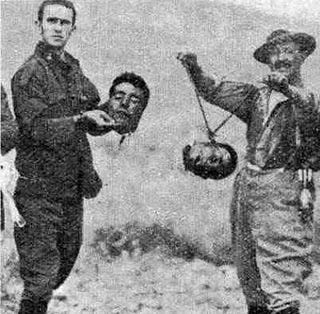
French troops in Algeria showing off the heads of Algerian resistance fighters

If we look at the facts, we can see ISIS is no more barbaric than the dictators, the Western elites have backed, in their 100 year domination of the region.
In relatively recent history in the very region ISIS now threatens, in the 1953 coup of Mordad.
Mohammad Reza Shah Pahlavi was installed as a monarch by Mi6 and the CIA. He immediately went about systematically killing and torturing anyone who opposed him.
When he was overthrown by a popular revolution, the West pushed Saddam Hussain to start a war with Iran, resulting in a million Muslims being killed.
Finding Saddam surplus to requirements, they tried to overthrow him. Using sanctions they starved and denied medical provisions to the Iraqi people. The UN reported that one and a half million children were malnourished, eventually half a million of those children would die.


As the award winning investigative journalist John Pilger noted:

“ It was like a medieval siege. Almost everything that sustained a modern state was, in the jargon, “blocked” — from chlorine for making the water supply safe to school pencils, parts for X-ray machines, common painkillers and drugs to combat cancer.

The British Government restricted the export of vaccines meant to protect Iraqi children against diphtheria and yellow fever. The Blair government, explained why. “The children’s vaccines”, they said, “were capable of being used in weapons of mass destruction”.

Under a bogus “humanitarian” Oil for Food Programme, $100 was allotted for each Iraqi to live on for a year. This figure had to pay for the entire society’s infrastructure and essential services, such as power and water. The majority of sick people could not even afford treatment. And make no mistake, this was deliberate. Von Sponeck the UN Coordinator said “I have not in the past wanted to use the word genocide, but now it is unavoidable.”

Disgusted, Von Sponeck resigned as UN Humanitarian Co-ordinator in Iraq. His predecessor, Denis Halliday, an equally distinguished senior UN official, had also resigned.”
“I was instructed,” Halliday said, “to implement a policy that satisfies the definition of genocide: a deliberate policy that has effectively killed well over a million individuals, children and adults.”

When that failed to dislodge Saddam, they bombed Iraq back to the stone age. Starting a war that cost another million Muslim lives.
We created hell; murdered millions, brutalised the regions inhabitants and then blamed the people that emerged from its ashes for not acting like poets and philosophers.

Across the region we installed brutal dictator, after brutal dictator. None of them more sane or humane than ISIS! And Muslims kept finding that these men were always kept in place through violence.

ISIS then is everything to do with our policies — right down to its brutality. Try as we might to deny it. It is a brutal, violent, reaction to a brutal, violent, order. An order we keep in place.
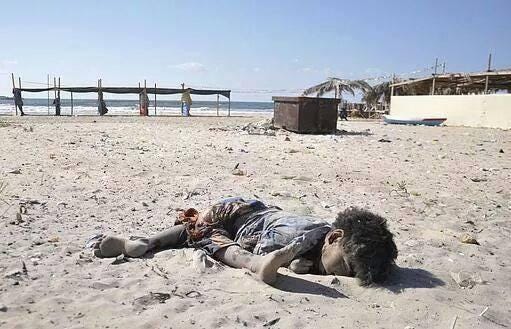
Just another dead Muslim child. Killed by Israel on a beach in Gaza.
The shocking fact is, that only weeks before they decided to bomb ISIS, both America and the UK confirmed their support for Israel and its right to defend itself. Even as it massacred 2,100 Palestinians civilians, 501 of them were children. In the end, over 11,000 men, women and children were wounded and 520,000 refugees were created as they tried to escape the vicious bombing of Gaza’s 1.8 million people, entrapped in an open-air prison with no escape.

ISIS in their wildest dreams could not compete with Israel’s arsenal of death, paid for by the American tax payer.

This moral case for war, was in fact nothing short of propaganda. Mark Curtis highlights in his book, Web of Deceit, how the British MoD had realised that public support for humanitarian wars — could help sell one.
The second argument is: If we do not attack them there, they will attack us here.

In fact the reverse is true. All terrorist attacks that have occurred against Western targets, have occurred, according to the terrorists themselves, because of Western foreign policy. Bin laden even laid out his reasons for fighting the West and every single point was linked to foreign policy. You can read more about this in the brilliant book ‘Imperial Hubris’ written by the CIA head of the Bin Laden Unit — Michael Scheuer.

If you really want to understand Muslim terrorism — read this book. He is one of the few non-Muslim white men who truly understand what is going on and has the courage to tell the truth despite attacks against him.
“This is about our security, contrary to Bush’s claim that we attack them for hating freedom. If we hated freedom, let him explain to us, why we don’t strike Sweden.” - Bin Laden Oct 2004

So if it is not about stopping terrorism, then why are they waging the a war against ISIS?
It is far less altruistic and far more obvious than the reasons they give to their corporate-media-duped public — but you have to go back into history to understand it.


For 100 years Western Elites have tried to keep the Muslim world from forming into a rising and possible rival power again.
They never forgot the conquest of Spain and their humiliating defeats, at the hands of a united Muslim Empire. So after the first world war, they decided as the British Prime Minister Lloyd George famously said ‘to make Islam innocuous’.
So when they had a chance to recreate the Muslim world, they created a structure in the Middle East that was inherently flawed. With inbuilt tensions amongst the communities and so constantly on the verge of fragmenting.
They manufactured lines in the sand, that cut through ancient communities. Sects were pitched against each other. All this was done to ensure the new nations, would always be internally fragmented and destabilised. The only way to keep them together was through repression. Hence the reason why they needed a dictator or a strongman. These strongmen of course were always dependant on the West to maintain the balance of power.
Both had a vested interest in keeping the prevalent order for any re-awakening would not only depose these leaders but challenge the order itself.

Vitally, the strongmen and the West needed to erase, any sense of a common, Muslim political identity — a pan-Islamic Muslim identity. By changing the peoples understanding of their past historical identity and implanting racial and nationalistic identities in its place — they fragmented the one unifier — Islam. Without a unifying identity — the Muslim world would never have a common struggle again. It could never unite.
The other major benefit of course, was it allowed them to steal its wealth — primarily oil.
This 100 year old game, was finally falling apart. From the Western strategists point of view, Tony Blair's real mistake and the real reason why they hate him, was that he had weakened the very order he was supposed to uphold.
By taking out the strongman in the region — the tensions built over a century — exploded.
Some analysts like Jonathan Cook in his excellent book ‘Israel and the Clash of Civilisations’ argued that Western Elites, along with Israel, did this on purpose. They had been planning to implement an even more radical carve up of the Middle East, a ‘Sykes-Picot’ version 2.
The book explains that they intended to carve up the current Middle Eastern nations into even smaller - weaker states (note the fragmentation of Libya and Iraq, after Western intervention).
But the growing momentum of groups taking to Jihad was threatening this.
The US found themselves facing forces, that were stronger than their puppet states and ones who would not play by the rules — their rules!
Western policy makers had two options.
The first was to stay out of the region and see the plan it had worked on, for over a century, fall apart. Leading to the embryonic rise of a Muslim Empire and the demise of cheap oil — The second was to go to war.
It was simple mathematics, a no brainer — that’s why we are going to war. It is as simple as that. Everything else, dear reader — is propaganda.
So why do I say the most powerful military powers in the World cannot beat a small group of armed zealots in the form of ISIS/L?
Simply this — they are not fighting ISIS/L. They are just another extreme manifestation of the root problem. They are fighting the IDEA that has grown in the minds of millions of Muslims. That idea is simple:
That the current western order is unjust and that peaceful ways of changing that order have been crushed, leaving only one option — to take up arms. Muslims had decided to revolt.
The West had one small window to stop this — the Arab Spring. Instead they undermined it. Leaving no option for many young men but take up armed struggle. It was a catastrophic mistake. It was only a matter of time that armed revolution would spread (war propagandists call this ‘Jihadist ideology’) — because they don’t want the public to understand it.
We now have two options open to us — leave the region alone and allow Muslims to make a destiny that is not dictated by the Western powers — or war
es it is true that if they leave the region, armed groups will rule for a while, some of them backward and barbaric - but overtime these would be replaced by state builders and mature into real civilisations. All revolutions are bloody, but eventually, all new states mature — even the Mongol’s changed over time.
There is, if we are honest — only one way to stop a violent reaction. Change the factors that have caused that reaction.
All talk of ‘jihadists’, ‘terrorists’, ‘extremists’, ‘Islamists’, ‘hate preachers’ or any other politically manufactured ‘unspeak’ is the war propagandists way of making sure you never understand this simple, concrete, insoluble — fact:
They don't hate us for our freedom, they hate us because we deny theirs.
How is it right for you to occupy our countries and kill our women and children and expect to live in peace and security? … the equation is clear: you are killed as you kill us and are kidnapped as you kidnap us…” Bin Laden Oct 2010
I leave you with a man who says it so much better than I can — Ron Paul