Showing posts with label Russia. Show all posts

Friday, 26 August 2016

Turkey, Russia, China Following U.S. Plan for Syria

READ THIS ON MY NEW WEBSITE: http://www.kamkashem.com/2016/08/26/turkey-russia-china-following-u-s-plan-for-syria/

There are often key moments in the world of geopolitics where if missed, leave one detached from the reality and consumed by the false narrative portrayed by the media.

After the intentionally flawed coup attempt in Turkey, you would have come across vast analysis by independent journalists who talk about the Russia vs America paradigm and often we get consumed by this narrative when trying to fish for information that isn't Fox News or the BBC. It’s the narrative the American neocons want us to believe, so that if "America doesn't get there first, Russia will".

Articles and analysis were posted hours after the coup explaining that Turkey will swing to the East and create a stronger Russian block or even Chinese considering they’re now involved in the Syrian quagmire.

However now we can see quite clearly that Russia, China, and Turkey are all following the American plan for the region. The Americans were the ones who drafted a Kurdistan region. The Americans were the ones who drafted autonomous "safe zones" in Syria, i.e. carving sectarian lines between the Kurds, Alawites and the rest of the Sunni population.

What are they getting by following the U.S plan?

This plan goes against Turkey’s territorial integrity because the Kurdish region directly threatens Turkey. It won’t be long before the issues in Turkey will escalate into chaos and they’ll have to draw concessions with the Kurdish State and let them annex the Kurdish area within Turkey - or simply keep Turkey in check through constant warfare and border issues.

So how does Turkey benefit from following the American plan? The fact is, they don’t. Turkey is under the thumb and if America wanted it can stage a real coup and take away Erdogan’s position. The purposefully flawed coup was a hint to Erdogan to say “We have more control in your country than you’d think”.

However, Erdogan did get something out of it, even if he loses some part of Turkey in the process. He has consolidated his position, removed his opposition, destroyed the judiciary that would have never let him continue with the American plan and he’s now going to finish his White Palace and live in it as a Presidential figure while the country is run by his ex-party. America rewards their agents from time to time if it suits them to do so.

Let’s look at Russia. If they’re some huge superpower people think them to be, why did they do a tactical retreat when they were on the verge of reclaiming Syria for Assad? Because this was not the American plan and whenever they do manoeuvres that are against American wishes, their own internal issues “coincidentally” flare up.

America’s watchful eye is ever present on Russia and they’ve held them by the proverbial for far too long — Crimea is just one of many choke-holds.

The other Baltic regions will be consumed by NATO if Russia doesn't play ball. In fact, Russia know that if they did not get involved in Syria which was always seen as a Russian-allied state historically, then they’d have nothing left there as America would have consumed it and replaced the government with Western puppets. It will still be the case, but this time, Russia would like to at least maintain their arms deals, trade, and semi-influence there.

Finally, it is well known that ISIS are trading with the likes of Turkey and exist through illicit financing from the West and if Turkey were honestly upset about American involvement in the coup, they wouldn't kiss and make up over a single Joe Biden visit. The institution misled the Turkish people by using anti-Americanism as a smokescreen while they shake hands behind closed doors.

Instead, anti-Americanism should have led to anti-American vision for Syria by cutting the supply routes for ISIS so they can no longer function, closing Incirlik airbase to both Russia and America, intercepting more airplanes that kill Muslims indiscriminately in Syria and calling for unity in the Muslim world.

READ THIS ON MY NEW WEBSITE: http://www.kamkashem.com/2016/08/26/turkey-russia-china-following-u-s-plan-for-syria/


Wednesday, 30 March 2016

Balkanisation of Syria: Starving the Population into Perpetual War

On 23 February, US Secretary of State John Kerry disclosed to the US Senate Foreign Relations Committee that separating Syria into multiple states is 'Plan B' if the ceasefire does not work. However it was evidently clear that the ceasefire was inconceivable, if not impossible to achieve due to there being more than 40+ factions on the ground fighting and vying for power. The fighting would rage on through the ceasefire. Jabhat al-Nusra and ISIS were not even included in this, leaving the U.S. with plenty of fingers to point at the rebel factions with.
One must realise that Russia were aware of this 'Plan B' from the very moment they stepped into the arena. Russia's sudden withdrawal when the Syrian Regime were in the strongest position they've been in 5 years. They had the ability to take back vast swathes of land from the rebels. This was evident by the fact many of these factions surrendered to the ceasefire to get a break from the Russian onslaught that didn't discriminate between combatant and non-combatants.
This is in line with the U.S. Department of Intelligence document leaked in 2015 in regards to the Syrian campaign. The document mentions that Russia will be there to 'support' the regime. Yet reporters, politicians and neoliberals feigned shock when Russia declared their military intervention - and they had to, as Russia are still the bogeyman for the U.S. to push through foreign policies on the basis of "otherwise Russia will take it".
The withdrawal of Russia has left the Syrian regime in a position whereby if they do not accept the U.S. plan then the rebels will slowly gain back the territory that Russia had helped them recapture. It also left the opposition factions with a threat that air support will not be withdrawn and therefore it is a case of 'take it or leave'. A perfect position for the U.S. proposed plan of balkanising Syria.

Friday, 26 February 2016

Is this the end of the American Civilization?

Testing the waters

An interesting debate has developed over the past couple of years. This debate argues that we are moving from a unipolar world whereby America, the sole undisputed world superpower, are losing its dominance in various parts of the world. They argue that other nations with ambitions to compete on a global scale are now testing the waters and standing up to this cut-throat hegemonic power, that is the U.S.

"Will the coming world order be the American universal empire?... The coming world order will mark the last phase in a historical transition and cap the revolutionary epoch of this century. The mission of the American people is to bury the nation states, lead their beheaved [sic] peoples into larger unions, and overawe with its might the would-be saboteurs of the new order who have nothing to offer mankind but a putrefying ideology and brute force. It is likely that the accomplishment of this mission will exhaust the energies of America and that, then, the historical center of gravity will shift to another people. But  this will matter little, for the opening of new horizons which we now faintly glimpse will usher in a new stage in human history... For the next 50 years or so, the future belongs to America." - U.S. Diplomat and Political Scientist Robert Strausz-Hupé (1957) 
 This U.S. political scientist made an accurate estimate of how the power will slowly begin to wane for the Americans fifty years on from the 1950's which brings us where we are today, although we can safely say that the power has not shifted away from them yet.

What is a unipolar world?

Unipolarity is the distribution of power whereby one nation or state exercises its influence in a economic, cultural, militaristic and political way unattested by any other state. This type of independent influence is something mankind has never seen before. A state that has access to the entire globe through its tactical capability, economic dominance and cultural indoctrination has never existed in the realm of life to this scale. The Roman Empire, nor the Islamic State had ever reached this level of total domination across the entire globe in so many aspects of life. However, the age of conflicts that we see today are signs of declining influence through the decreasing rate of expansion, class conflicts within their own society, imperialist wars and irrationality. 

The discussion of multipolarity has arisen in recent times, especially after the Middle East and North African uprisings. The 'vassals' of the American empire have begun to rebel and are increasingly formulating their own foreign policy. These 'vassals', such as those that have been incumbent upon IMF or other American imposed sanctions have turned to rival centres of power such as Moscow and Beijing for economic and political assistance. The U.S. National Intelligence Council in a report titled Global Trends 2025: A Transformed World professes that by 2025, "the international system will be a global multipolar one with gaps in national power."

Martin Jacques wrote in his work When China Rules the World: The End of the Western World and the Birth of a New Global Order that although China's global pre-eminence are economic, eventually China's political and cultural influence will be even greater and Mearsheimer in 2005 concurs that the "United States and China are likely to engage in an intense security competition with considerable potential for war." It can be noted that America's pivot to Asia, the Department of Defence announced plans to move 60% of its naval forces to the Pacific, which is by far one of its biggest military and strategic escalation after the Cold War. It is clear the American's are fighting a battle on many fronts, with the resurgence of the Islamic ideology being at the forefront, and astoundingly the intellectuals fail to identify it or write about it.

Buck-passing Policy of the U.S.

Mearsheimer (2001) mentions in his book titled The Tragedy of Great Power Politics that "buck-passing is a threatened great power's main alternative to balancing... to get another state to bear the burden of deterring or possibly fighting an aggressor while it remains on the sidelines". Which has been the policy for the U.S. Administration under Barrack Obama. It is a real sign of weakness of ones ideology, that it cannot express its culture freely without it causing internal problems for its own society. A state that is killing itself from within.

The Seven Stages of a Civilizations Rise and Fall

Carrol Quigley in 1961 published a book that studied the stages that all civilizations go through before its final decay and invasion. He concluded that there are seven stages, namely; mixture, gestation, expansion, age of conflicts, universal empire, decay and invasion. We can study where the American Empire currently stands in terms of these stages. 

The first stage of "mixture" is where all civilizations begin with a mixture of two or more cultures. "Such mixture of cultures is very common; in fact, it occurs at the boundaries of all cultures to some extent. But such casual cultural mixture is of little significance unless there comes into existence in the zone of mixture a new culture, arising from the mixture but different from the constituent parts. The process is a little like the way in which a mixture of chemicals sometimes produces a new compound different from the mixing chemicals. In the case we are discussing, the new compound is a new society with a new culture. The contributing societies may be civilizations or merely producing societies Such mixture of cultures is very common; in fact, it occurs at the boundaries of all cultures to some extent. But such casual cultural mixture is of little significance unless there comes into existence in the zone of mixture a new culture, arising from the mixture but different from the constituent parts. In the case we are discussing, the new compound is a new society with a new culture. The contributing societies may be civilizations or merely producing societies (agricultural or pastoral) or merely parasitic societies (with hunting or fishing). Of the millions of cases of such cultural mixture that are occurring all the time, only rarely does there appear a new society. And even more rarely does this new society become organized in such a way that it is a producing society with an instrument of expansion. In the rare case where this occurs, we have the first stage of a new civilization. The fact that there have been no more than two dozen civilizations in almost ten thousand years of cultural mixture of producing societies will indicate how rare this occurrence is." It is clear that the American civilization began in the 17th century but was not at this stage, an empire at a global scale.

The second stage, called the "gestation" stage is, by definition, a period in which "nothing sensational happens, it is not an easy period to discern in the prehistoric evidence. If we assume that the first agriculturalists came into Mesopotamia about 6000 B.C., we might postulate a period of mixture for about a thousand years and a period of gestation about half as long." One can argue that during this period the society is growing and the relationships amongst them are becoming common, whether that be remnants from a previous culture or a brand new one. One can conclude this gestation period lasted at most 50-100 years but ended definitely before the 19th century.

The third stage being the Age of Expansion, and in this period "some of the most significant advances in human history were either made or adapted to large-scale. This is quite clearly the period America went through in the 19th century. The industrial production doubled and the economy grew rapidly. All due to the fact the Europeans economies were exhausted in World War I. The age of mass production had arrived allowing the Americans to make full effect of it sooner than others.

The fourth stage, namely the Age of Conflicts, has been defined by Quigley "as extending from the date when the rate of expansion begins to decline to the period when one political unit establishes a universal empire by conquering the entire area of the civilization. In the earlier part of this period the whole core of the civilization may be conquered by one or more preliminary empires." Quigley goes on to state certain characteristics of the Age of Conflicts to be "(1) decreasing rate of expansion, (2) imperialist wars, (3) class conflicts, and (4) irrationality." During this Age of Conflicts, which one can safely assume was between 1900 up until the 1980's at the end of the Cold War and the collapse of the Communist ideology. The class conflicts had caused many internal issues for America and its peoples but they would argue that this was a form of evolution, leading up to a more pure form of liberalism.

The fifth stage is the Universal Empire and as a result of the imperialist wars in the Age of Conflicts, the number of political units in the civilization is reduced to one. This can be seen at both a local level and a national level. Internal feuds and civil wars are quelled while other civilizations that are existent in the world are dominated.
When a universal empire is established in a civilization, the society enters upon a “golden age.” At least this is what it seems to the periods that follow it. Such a golden age is a period of peace and of relative prosperity. Peace arises from the absence of any competing political unity within the area of the civilization itself, and from the remoteness or even absence of struggles with other societies outside. Prosperity arises from the ending of internal belligerent destruction, the reduction of internal trade barriers, the establishment of a common system of weights, measures, and coinage, and from the extensive government spending associated with the establishment of a universal empire. But this appearance of prosperity is deceptive. Little real economic expansion is possible because no real instrument of expansion exists. 
The golden age is really the glow of over ripeness, and soon decline begins. When it becomes evident, we pass from Stage 5 of the Universal Empire to Stage 6 of Decay. One finds it difficult to put a finger on when this golden age actually transpired for the Americans, but one could argue that the day George W. Bush announced the "Global World Order". However this Universal Empire we can quite clearly see is dwindling, is it entering the penultimate stage of decay?

The sixth stage as already mentioned is the Stage of Decay. Quigley's explanation of the Stage of Decay can explain the situation of America and its peoples clearly. 
The Stage of Decay is a period of acute economic depression, declining standards of living, civil wars between the various vested interests, and growing illiteracy. The society grows weaker and weaker. Vain efforts are made to stop the wastage by legislation. But the decline continues. The religious, intellectual, social, and political levels of the society begin to lose the allegiance of the masses of the people on a large scale. New religious movements begin to sweep over the society. There is a growing reluctance to fight for the society or even to support it by paying taxes.
It is possible to break down these factors and apply them to America and the American people. In terms of the acute economic depression, America has suffered an astonishing 47 recessions since the 1790's, but if we are to look at all the recent recessions after the "Great Depression of 1929", they were all but a few due to economic policies or financial crises. 

In terms of the declining standards of living, America was turning towards a "knowledge society", meaning that it wished to pursue a 'post-industrial' society that instead of capital investment in productive activity in plant and equipment, its main feature was the creation of a "knowledge society," with a focus on technical dynamics and menial industrial labour was better suited to developing countries. However the truth of the matter is the vast majority of Americans have worked harder and longer hours. Wal-Mart, America's largest employer, pays less than a third of the level of wages and benefits auto-workers received. Also, under 'Obamacare' the health care in America has suffered a great deal which further proves the decline in the standards of living. 

In terms of illiteracy in the United States, a recent study conducted in April 2015 by the U.S. Department of Education and the National Institute of Literacy states that 32 million adults in the U.S. cannot read, and that is 14% of the population. It goes on to state that the illiteracy levels have not improved for the last ten years, showcasing that illiteracy is not improving. One can state that if the people of America are not progressing, they are declining. 

The final stage of the rise and fall of a civilization is the Stage of Invasion which we can safely say has not occurred up until now. 

The most important point that many authors, political scientists and politicians fail to mention is that the Islamic revival of the Muslims in the world today, do not have a state mechanism, yet they provide the biggest challenge for all the actors in the world today. It is not de-industrialisation that causes a civilization to dwindle and die but rather it is the idea of those people that must be destroyed. The Islamic Empire was abolished in 1924 however the ideology remained in the hearts of the 200 million that lived in the world at the time and to this very day. These authors and political scientists write books upon books of the swaying influence, and how India or China or Germany will take the reign as the global superpower, yet these nations they state are struggling against the rise of Islam. It is either naivety or academic ignorance or outright propaganda that they fail to point the finger on the Muslims to be the next civilization that will unseat the rest of them. The only civilization that does not fit into the seven stages is the Islamic civilization that has remained since the demise of its state mechanism. 

However I leave it to the reader to decide whether the American civilization has either cemented itself firmly to survive for many more decades or whether they are fighting a losing battle. 

Written by Kam Kashem

Robert Strausz-Hupé (1957) - "The Balance of Tomorrow" Obris: A Quarterly Journal of World Affairs Volume 1, Number 1.
Zbigniew Brzezinski and John J. Mearsheimer, "Clash of the Titans" Foreign Policy, Jan/Feb 2005, 146
Mearsheimer (2001) - "The Tragedy of Great Power Politics"
Carrol Quigley (1961) - "The Evolutions of Civilizations"
Christopher L. Brennan (2015) - "Fall of the Arab Spring from Revolution to Destruction"

Friday, 19 February 2016

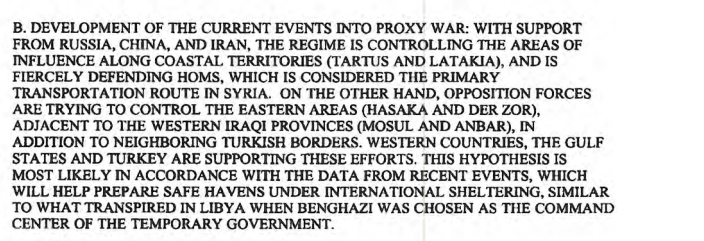
US CENTCOM Commander General John P.Abizaid Urges Sykes-Picot 2

The Combating Terrorism Center (CTC) have recently published an interview with the ex US CENTCOM commander John P.Abizaid on the topic of the Middle East.

Bear in mind that this man served 34 years, the longest serving commander of the US CENTCOM and has been involved in many of the huge foreign policy decisions in the West, this is no ex-army officer talking on Press TV and claiming "Israel" controls the world - i.e. this is no conspiracy theorist. CTC are a huge think-tank organisation who like RAND and the Brookings Institute, shape the policies for the West going forward.

Now, he was posed the question, "In your opinion, what should be our strategic end state in this conflict?" and in his response he said that "It is hard to say what the strategic end state would be because Sunni Islamic extremism is an idea, and it is hard to destroy an idea. It’s an ideology." 

Exactly, and this is a point most Muslims fail to understand. The West themselves know that Islam is an ideology and that it is the IDEA of Islam they are trying to destroy. This is not contrary to what Allah (swt) tells the Muslims in the Holy Qur'an.

Now this isn't the point that spurred me on to write this article. It is the question he was posed after this.... read carefully.

The post-WW1 borders is the Sykes-Picot Agreement was in 1916 as we know that WW1 was in 1914. This is clearly talking about the Sykes-Picot Agreement which saw the Middle East split up into the various states we see today. 

Obviously the West can't conclude that they are the ones stoking up sectarianism in the region to establish new lines in the sand but effectively that is what is happening and as always the crocodile tears, is aimed at the Muslims not being able to live peacefully with each other. 

Now if you have read my other articles in relation to the West collusion with Russia and various factions on the ground whether that be consciously or not - the fact of the matter is, the factions on the ground are allowed to exist due to the support that is given to them by huge state sponsors, i.e. a proxy war. 

This redrawing of the Middle East on sectarian lines which they themselves have harnessed and allowed through arming, funding and fundamentally supporting is the new policy going forward and it is very rarely spoken about so plainly! As you can see his response after making that statement was that "most people will clutch their heart, and do cluth their heart, every time I say something like that..." And rightly so! 

If the Muslims were aware of what the plan was for their lands, they wouldn't be so easily duped and embroiled in sectarian struggles. 

Please make the Ummah aware of Sykes-Picot 2, it divided us once and set us back 100's of years, and it'll set us back another 100 years. 

#SykesPicot2 


Tuesday, 5 January 2016

Turkey swings to the West and the Muslims lose hope in Islam

Just a decade ago Turkey had met the set of democracy and governance-related requirements as a candidate for the European Union. Their economy was booming and their policy of keeping peace with neighbours allowed them to trade with ease and efficiency. They were setting themselves as a model democracy for the Middle East and the Muslims.

However, there has been a growing call by the Muslims across the globe for Islam to be implemented politically and not just spiritually. In order to preserve the progress Turkey had made, She had to listen to these wishes in a way that would not send liberal democracy a death sentence.

Thus began the brandishing of the Holy Qur'an by Erdogan in order to quell the thirst of the Muslims. It included the introduction of interest-free banking and tougher laws on religious marriages and adultery.

However this move to a more 'Islamic'-coated democracy, which is far from Islam, has introduced other domestic issues which were kept quiet a decade ago. The once quiet neighbour policy of the Turkish government to an aggressive stance that heavily includes themselves in the Syria and Iraq quagmire as well as the forerunner in the refugee crises, has brought about terrorist attacks and a struggling economy that has now broken ties with Russia that supplied 60% of its countries energy after the downing of the Russian jet.

What has this new turn in Turkish politics achieved?


  1. When the Muslims lose their high standard of living, it'll bring doubts into many that Islam cannot play any role in politics, even though currently this form of picking and choosing from Islam does not make a secular state into an Islamic state. 
  2. The Muslims have experienced gradualism under the Muslim Brotherhood in Egypt and now a democracy led by 'Islamists' - both which have failed them domestically, in order to make the Muslims lose hope in Islam as a political ideology.
  3. Turkey will fall into the arms of both the EU and the U.S. which will force it to abandon the little Islam it has in governance in return for a booming economy and strong alliance once again. 
The longer the AKP use a heavy hand on the Kurds the faster its popularity will diminish, allowing for the opposition to ride the waves of secular democracy devoid of any religious laws to take the front seat and affirm that Islam cannot achieve the basic needs of the people. No wonder Erdogan had sought to take a higher role that will make him immune to the coming changes? 

This also leads one to believe that this U.S and Russia antipathy towards each other, is but a farcical to delude and deceive their own masses in order to effectuate change. 

The U.S. has achieved more than it has bargained for with this new direction by Turkey. The abandonment of the Chinese missile deal and the reconciliation with 'Israel', as well as the improved cooperation with NATO means there will be closely aligned agenda on Syria and Iraq with the U.S. 

It will be interesting to see how the AKP fare domestically after this huge swing to the West for Turkey. 


Wednesday, 23 December 2015

RAND's peace plan for Syria

RAND Report: http://www.rand.org/content/dam/rand/pubs/perspectives/PE100/PE182/RAND_PE182.pdf

It is important to know that the RAND corporation are no ordinary think-tank. They are one of the leading think-tanks in America that have shaped policy and decision making at the highest level. This is why any analysis that come out of RAND, you can be sure that it is the direction the politicians will take in America.

This recent report by RAND regarding the peace plan for Syria agrees with much of the Brooking's Institutions report on deconstructing Syria towards a regionalized strategy.

The report starts off by recognising the two paths that can be taken in Syria, them being:

  1. Concentrate on brokering a comprehensive political arrangement among the warring Syrian parties and their external sponsors, including the reform of state institutions, the formation of a new government, and a plan for elections, accompanied by a ceasefire and the beginning of a process of reconstruction.
  2. The second approach would be to secure agreement to an immediate ceasefire, which would be followed by further negotiations on the shape of a reconstituted Syrian state and government.

We can see that the West are currently aiming for the first path by gathering the opposition to come to an agreement. However whether or not Assad stays or leaves is the main sticking point for most of the warring factions - something that Russia also wish to have a say in. 

RAND suggest that path one is unrealistic now that sectarianism is as rife as ever. 
"pitting the regime against the opposition, Shi’a against Sunni, Arab against Kurd, and moderate against extremist. It has attracted tens of thousands of foreign fighters from Europe, North America, and Africa; exacerbated geopolitical rivalries among Saudi Arabia, Iran, Russia, the United States, and others; and drawn in the armed forces of nearly a dozen external states. There may have been a time, early on, when it could be argued that the benefits of overthrowing Assad would be worth the human, strategic, political, and economic costs of achieving that goal, but that time has long past. At this point, whether President Assad stays or goes in the near term should be regarded as a matter of pure expediency"

Whereas the second path seems to be more achievable according to both RAND and the Brooking's Institute. The most telling point of this report is the acknowledgement of three safe zones for Syria. RAND writes:

"Were the fighting to be halted on the basis of the territory currently held, Syria would find itself divided into roughly four zones—one controlled by the government; one controlled by the Kurds; one controlled by diverse elements of the Sunni opposition; and one controlled largely by the Islamic State of Iraq and Syria (ISIS).1 As ISIS has no foreign sponsors, is largely immune to external influence, and is certain to reject any ceasefire, Syria would effectively be divided into three “safe” zones in which the parties agreed to stop fighting, and one zone in which all other parties would be free to wage war on ISIS."

 RAND's proposal acknowledges three difficult realities.

  1. The first is that four years of fighting and more than a quarter million dead have left Syria intensely divided by sect and ethnicity. It should be a goal to mitigate those divisions in the long run, but they must be acknowledged in the short run.
  2. Second, ousting the current regime by building up the military power of the opposition—the basic approach of the United States and its partners for the past four years—is unlikely to succeed. Russia and Iran have proven so committed to the regime’s preservation that escalation of the conflict has not led to Assad’s capitulation, but rather a significant counter-escalation, more killing and refugees, and radicalization of the opposition.
  3. Third, the current battle lines on the ground, while hardly ideal, would have to be the fundamental basis of any armistice. Limited territorial swaps may be necessary to facilitate the disengagement of combatants and assist in ceasefire implementation.

It goes on to state that the war in Syria has ruined the intermixing of  ethnicities and sects within Syria, thus forming regions based on them or creating lines in the sand, what some would call Sykes-Picot Part 2.

 "Like most countries in the Middle East, Syria’s ethno-sectarian breakdown is far from clean. Syria’s communities have historically intermixed, so there is no such thing as a solid stretch of land inhabited by a single community. In addition, Sunni Arabs constitute more than 60 percent of the country’s total population. They are present throughout the country, comprise A ceasefire may not be a sufficient condition for an eventual political settlement, but it is likely to be a necessary one. 3 a majority even in regime-held areas, and in many cases remain loyal to the Assad regime.4 These important caveats aside, Syria’s longstanding ethnosectarian map does reflect regional groupings, which have been consolidated by internal displacement"
Without the war in Syria it would have never been possible to split Syria up on ethnic and sectarian lines. One could call this the sickest method of separating the Ummah of Muhammad (pbuh).


The map above shows the clear zones that RAND are suggesting in their proposal for Syria. In the full report you will find more maps relating to sects within Syria before and after the war. 

It is also interesting to note how RAND suggest each of these players are backed by international support to secure its own interests.

Thus, Russia and Iran would guarantee the regime’s adherence; the United States would guarantee Kurdish adherence; and Turkey and Jordan would guarantee the Sunni opposition’s adherence. All external parties would collaborate to dislodge ISIS. 
However I do believe that the final point about all external parties collaborating to defeat ISIS is only mentioned due to the fact ISIS have been used as a pretext for all this change in the Muslim world and also to contain the Muslims from seeking an alternative system. It will be interesting to see how long ISIS remain after the Syria end game is played out. They will either cease to exist or kept like Al Qaeda as a pretext into other parts of the Muslim world where the West require change. So far they have become the golden egg for the West and so easily allowed them to dictate the situation for the rest of the world under the guise of "terrorism".

It goes on to mention that it could become somewhat similar to Lebanon's sectarian power sharing model including the international oversight on the Bosnia model using U.N forces to implement ceasefire and support. If this is the case, the Muslims should look back at what happened to the Bosnian Muslims as the Serbs slaughtered them in U.N's presence. It would be a disaster to allow them to "protect" the Muslims.
"International oversight of the ceasefire and support for the political process would be undertaken by a Peace Implementation Council, on the Bosnia model, made up of the above-mentioned states plus others ready to contribute significantly. "
It clearly admits that support for Al Nusra and other groups currently receive support and will stop receiving it once the above actions have been taken.

"It would have to be clear to all groups that external support will be cut off for groups that violate the ceasefire."
 In conclusion it is clear to see that this second path is on its way already as Russia have now become a key player in the Syria end game, and was needed in order to support Assad in a alawi region and be their main guarantor.

Kam Kashem

Friday, 18 December 2015

The "Islamic" Military Alliance by Abu Usaid

Observers of the research released by the US strategic centres can perceive clearly the policies America pursues in our lands. They have determined that in order to prevent the rise of an "Islamic State", or in case the current regimes failed, the US should move away from the "soft power" and the "idealist approach"  and resort to "hard power" and "realpolitik". As for the "Jihadi" movements, it is imperative to deal with them according to the following steps: they should be contained and recruited; and if the containment failed, it is imperative to provide their opponents with "Indirect Military Support" then resort to "Indirect Military Intervention" against them and then resort to "Keeping Them Out."  


If the Muslims wished to engage in a struggle against their enemies in order to achieve liberation and revival, they ought to perceive the doctrine of the enemies, their plans and their adopted styles and means of execution. Capitalism is the doctrine upon which Western thought is built and expediency is the viewpoint towards life and the criterion that determines their behaviour, and colonialism, in all its forms, is the method through which they acquire the benefits, repel the detriments and achieve their interests. Their strategy towards the Muslims involves eroding the political feature of Islam from the life of the Muslims and confining it to the rituals which does not influence ruling matters, especially in respect of the Ummah's relationship with other nations and peoples. Once the Ummah has accepted the doctrine of separating religion from life, even with her own acknowledgment and approval, her mentality will be hijacked, her volition will be forfeited  and her intellectual compass will be deviated; she will then think like her enemies do, accept what they decide and head to wherever they want. As for the styles and means, these are numerous and they vary according to the conditions and situations and they include direct and indirect "hard power" as we mentioned earlier, or "soft power" which includes the diplomatic activities and the generating of influence through agents, rulers, armies, media, judiciary, scholars and movements.   


These issues are among the most important political concepts the Muslims should acquire in order to perceive the political activities of their enemies. Hence, we may through such activities pass judgement on the political situation in the "Arab Spring" countries. In Syria, the American political activities towards the armed movements are still at the stage of recruiting some of them and attempting to contain the others; all the movements are recruited to fight the Syrian regime with the backing of America's agents in the Gulf and Turkey. However, some of the movements are yet to be contained and some of their members are yet to be tamed into accepting the post-Assad phase.


Hence, the categorising process took place at the Riyadh conference in order to implement the strategies of "Containment", "Indirect Military Support", "Indirect Military Intervention" and "Keeping Them Out". The decision to establish the "Islamic Military Alliance" to combat terror after the Riyadh conference has come to epitomise the American strategy of "Indirect Military Intervention" to isolate and keep  the opponents out. The task of this alliance will include areas in Syria, Iraq and Libya. As for Yemen, the situation is different on the ground since al-Houthi group is undertaking the role of servant for the American plan to fragment Yemen, while the Saudi military machine works towards maintaining an equilibrium among the Yemeni warring factions and preventing the fireball from reaching Saudi Arabia. If the alliance were compelled to intervene in Yemen against the Houthis, it would merely be to tame them and keep them under control rather than to destroy them.
Establishing  a military alliance with an "Islamic" flavour will undoubtedly justify the rejection of the undesirable foreign military interventions in the future, such as the Russian intervention. America managed to drag Russia into the Syrian quagmire and implicate her with the Muslims, so that her belligerence may turn into anger and resentment among the Islamic constituent of 25 million in Russia, thus weakening the coherence of the Russian Federation and threatening its existence.


The "Islamic" military alliance is also set to end or scale down the military services offered by Europe who always seeks a slice of the oil pie in return; France and Britain had demanded a third of the oil and building contracts before the military operation against the Gaddafi regime in Libya started. Those who think that the prospective  "Islamic" alliance will be in the interest of the Muslims are woolgathering because most of the Arab states have open and covert ties and treaties with the "Israeli" entity and are involved in military alliances with the world powers which means that such an alliance would target the Muslims rather than their enemies.

The "Islamic" alliance aims also to sidestep the Russian military campaign that has affected the efficacy of the aerial military campaign led by the US. There may also be an American plan to curtail the role of Daesh in Syria and Iraq through the "Islamic" alliance in order to nullify the pretexts of the Russian military campaign upon which Putin is relying to sustain his popularity inside Russia. Furthermore, the intervention of the alliance would dampen the aspirations of Iran in Syria and Iraq and prevent Hezbollah from achieving political gains to consolidate its domestic influence and increase its stake in the Lebanese regime.


"And if they had intended to march out, certainly, they would have made some preparation for it, but Allah was averse to their being sent forth, so He made them lag behind, and it was said (to them), "Sit you among those who sit (at home)." [9-46]


"Had they marched out with you, they would have added to you nothing except disorder, and they would have hurried about in your midst (spreading corruption) and sowing sedition among you, and there are some among you who would have listened to them. And Allah is the All-Knower of the evildoers." [9-47]


"Say: "Nothing shall ever happen to us except what Allah has ordained for us. He is our Lord And in Allah let the believers put their trust." [9-51]
"They swear by Allah that they are truly of you while they are not of you, but they are a people who are afraid." [9-56]

16 December 2015
Abu Usaid


Thursday, 17 December 2015

The Jihadis - A Pawn for the West

A recent confab took place in Saudi Arabia which included "opposition" leaders from the factions fighting in Syria, namely Ahrar al-Sham and Jaysh al-Islam, both affiliated to Al-Nusra Front who are a designated foreign terrorist organisation according to America - Saudi's greatest ally.

After great strides made in Syria against Assad it was about time that they'd be put back into their place by America's "enemy" Russia - but what has this achieved?

1) Allows the West to negotiate with the "rebels" temporarily until a deal is struck
a) Then wipes them out after claiming they have sided with Al Qaeda - similar to how most of the Jihadi factions were used and abused in the past after they've aided in the West's plans.

2) It forces the many factions on the ground to compromise the political solution for Syria
a) Giving up the Sharia in return for a liberal democratic form of governance, contrary to what most of the factions call for.

3) Preserves the face of America as it is the 'Russian Bear' that is delivering the blows while America are the peacemakers that will inevitably be the leader in coming to a political solution. 
a) At the same time it weakens the Russians, pulling them in to a battle that they'll never be able to come out of without a dent, both domestically and internationally. 
b) Creates a wedge between Russia and Turkey that will affect Russia moreso than Turkey due to its high dependency on trade after the sanctions with the European states. 


As for the Jihadi's, well... better luck next time. Sincere intentions, but the wrong method. However the sympathy shouldn't be with them but rather the millions of innocent Muslims that will die due to their carelessness and inability to stick to the Prophetic method of bringing Islam back as a State. 

May Allah make us one of those who persevere in the correct manner and in the manner that won't be detrimental to the Ummah of Muhammad (sallalahu alayhi wasallam)

Kam Kashem


Tuesday, 1 December 2015

Terror in Mali: An Attack on China and Russia?


International media have now confirmed that at least nine of the 27 killed in the attack were Chinese and Russian. While this alone would indeed be curious, it is the identities and positions of those killed that is particularly striking. The three Chinese victims were important figures in China’s China Railway Construction Corporation (CRCC), while the Russians were employees of Russian airline Volga-Dnepr. That it was these individuals who were killed at the very outset of the attack suggests that they were the likely targets of what could perhaps rightly be called a terrorist assassination operation.

But why these men? And why now? To answer these questions, one must have an understanding of the roles of both these companies in Mali and, at the larger level, the activities of China and Russia in Mali. Moreover, the targeted killing should be seen in light of the growing assertiveness of both countries against terrorism in Syria and internationally. Considering the strategic partnership between the two countries – a partnership that is expanding seemingly every day – it seems that the fight against terrorism has become yet another point of convergence between Moscow and Beijing. In addition, it must be recalled that both countries have had their share of terror attacks in recent years, with each having made counter-terrorism a central element in their national security strategies, as well as their foreign policy.

And so, given these basic facts, it becomes clear that the attack in Mali was no random act of terrorism, but a carefully planned and executed operation designed to send a clear message to Russia and China.

The Attack, the Victims, and the Significance

On Friday November 20, 2015 a team of reportedly “heavily armed and well-trained gunmen” attacked a well known international hotel in Bamako, Mali. While the initial reports were somewhat sketchy and contradictory, in the days since the attack and siege that followed, new details have emerged that are undeniably worrying as they provide a potential motive for the terrorists.

It is has since been announced that three Chinese nationals were killed at the outset of the attack: Zhou Tianxiang, Wang Xuanshang, and Chang Xuehui. Aside from the obviously tragic fact that these men were murdered in cold blood, one must examine carefully who they were in order to get a full sense of the importance of their killings. Mr. Zhou was the General Manager of the China Railway Construction Corporation’s (CRCC) international group, Mr. Wang was the Deputy General Manager of CRCC’s international group, and Mr. Chang was General Manager of the CRCC’s West Africa division. The significance should become immediately apparent as these men were the principal liaisons between Beijing and the Malian government in the major railway investments that China has made in Mali. With railway construction being one of the key infrastructure and economic development programs in landlocked Mali, the deaths of these three Chinese nationals is clearly both a symbolic and very tangible attack on China’s partnership with Mali.

In late 2014, Mali’s President Ibrahim Boubacar Keita traveled to China to attend the World Economic Forum in Tianjin. On the sidelines of the forum the Malian president sealed a number of critical development deals with the Chinese government, the most high-profile of which were railway construction and improvement agreements. Chief among the projects is the construction of an $8 billion, 900km railway linking Mali’s capital of Bamako with the Atlantic port and capital of neighboring Guinea, Conakry. The project, seen by many experts as essential for bringing Malian mineral wealth to world markets, is critical to the economic development of the country. Additionally, CRCC was also tapped to renovate the railway connecting Bamako with Senegal’s capital of Dakar, with the project carrying a price tag of nearly $1.5 billion.

These two projects alone were worth nearly $10 billion, while a number of other projects, including road construction throughout the conflict-ridden north of the country, as well as construction of a much needed new bridge in gridlock-plagued Bamako, brought the cumulative worth of the Chinese investments to near (or above) the total GDP for Mali ($12 billion in 2014). Such massive investments in the country were obviously of great significance to the Malian government both because of their economically transformative qualities, and also because they had solidified China as perhaps the single most dominant investor in Mali, a country long since under the post-colonial economic yoke of France, and military yoke of the United States.

It seems highly implausible, to say the least, that a random terror attack solely interested in killing as many civilians as possible would have as its first three victims these three men, perhaps three of the most important men in the country at the time. But the implausible coincidences don’t stop there.

Among the dead are also six Russians, all of whom are said to have been employees of the Russian commercial cargo airline Volga-Dnepr. While at first glance it may seem irrelevant that the Russian victims worked for an airline, it is in fact very telling as it indicates a similar motive to the killing of the Chinese nationals; specifically, Volga-Dnepr is, according to its Wikipedia page, “a world leader in the global market for the movement of oversize, unique and heavy air cargo…[It] serves governmental and commercial organizations, including leading global businesses in the oil and gas, energy, aerospace, agriculture and telecommunications industries as well as the humanitarian and emergency services sectors.” The company has transported everything from gigantic excavators to airplanes, helicopters, mini-factories, and power plants, not to mention heavy machines used in energy extraction.

And so, their killing, like that of the CRCC executives, is a symbolic strike against Chinese and Russian investment in the country. And perhaps even more importantly, the attack was a symbolic attack upon the very nature of Sino-Russian collaboration and partnership, especially in the context of economic development in Africa and the Global South.

It would be worthwhile to add that Volga-Dnepr has also been involved in military transport services for NATO and the US until at least the beginning of the Ukraine conflict and Crimea’s reunification with Russia. Whether this fact has any bearing on the employees being targeted, that would be pure conjecture. Suffice to say though that Volga-Dnepr was no ordinary airline, but one that was integral to the entire economic development initiative in Mali. And this is really the key point: China and Russia are development partners for the former French colonial possession and US puppet state.

To be sure, China is not offering such deals to Mali solely out of altruism and in the spirit of generosity; naturally China expects to enrich itself and ensure access to raw materials, resources, and markets in Mali now and in the future. This is the sort of “win-win” partnership forever being touted by China as the cornerstone of its aid and investment throughout Africa. Indeed, in many ways, Mali is a prime example of just how China operates on the continent. Rather than a purely exploitative investment model (the IMF and World Bank examples come to mind), China is engaging in true partnership. And, contrary to what many have argued (that China is merely a rival imperialist power in Africa), China’s activities in Africa are by and large productive for the whole of the countries where China invests, a few egregious bad examples aside.

China is a friend of Africa, and it has demonstrated that repeatedly throughout the last decade. And perhaps it is just this sort of friendship that was under attack in the Radisson Blu Hotel in Bamako.


While the world has been transfixed by terrorism from the downing of the Russian airliner in Egypt, to the inhuman attacks in Paris and Beirut, not nearly enough attention has been paid to the attack in Mali. Perhaps one of the reasons the episode has not gotten the necessary scrutiny and investigation is the seemingly endless series of terror attacks that have transfixed news consumers worldwide. Perhaps it is simply good old fashioned racism that sees Africa as little more than a collection of chaotic states constantly in conflict, with violence and death being the norm.

Or maybe the real reason almost no one has shined a light on this episode is because of the global implications of the killings, and the obvious message they sent. While media organizations seem to have deliberately ignored the implication of the attacks of November 20th in Mali, one can rest assured that Beijing and Moscow got the message loud and clear. And one can also rest assured that the Chinese and Russians are well aware of the true motives of the attack. The question remains: how will these countries respond?

Source: http://landdestroyer.blogspot.co.uk/2015/11/terror-in-mali-attack-on-china-and.html#more


Monday, 9 November 2015

Putin’s aspirations lead Russia towards disaster

The Russian military operations in Syria still raise many questions regarding the objectives, limits, duration and chances of achieving their goal of reinstalling Moscow as a dominant world power.
Russia’s conflict with the West came about as a result of the deployment of a US missile shield in Europe, Washington’s update of its tactical nuclear weapons and NATO’s advancement towards its western border. After Putin’s enthusiastic efforts to achieve closer integration with Europe and the West in general during his first three years in power, he changed direction suddenly and worked towards building a strong state. His strategy was based on two axes: Russia’s near neighbours and those further away. He has sought to regain control of what he considers to be Russian territory annexed by neighbouring countries and to restore Moscow’s control in the former Soviet Union countries under the pretext of protecting ethnic Russians and Russian speakers. The goal behind the second axis is to limit America’s global role and influence and to allow Russia to play a prominent role in international decision-making.
These efforts include working towards Russia regaining its position in an international system based on bipolarity alongside the US. In order to achieve this, Putin launched economic and military programmes to regain balance within Russia and increase its ability to take regional and international action to impose its presence and boost its prestige.
Hence, he worked on strengthening Russia’s military presence in the former Soviet Union by means of military bases and strengthening the Collective Security Treaty Organisation. He also called for the formation of a customs union to include the former Soviet Union countries and for the adoption of a military doctrine based on reinforcing missile defences and the development of carrying systems for nuclear warheads, such as missiles, submarines and strategic bombs. Conventional weapons have also been modernised, with an operational command and naval fleet based permanently in the Mediterranean. In addition, a network of military bases has been built to house air defence forces, rapid reaction brigades and navy vessels deployed above the Arctic Circle.
Having adopted brinkmanship as a tactic, Putin is also doing a lot of muscle-flexing, and is hinting at the possibility of the outbreak of a world war. Russia’s spending on arms now exceeds 9 per cent of GDP as the president deploys aircraft and ships around the world.
The outbreak of the Arab Spring revolutions sparked additional disputes between Russia and the West, especially after the latter’s intervention in Libya, depriving Russia of its piece of the cake, as well as threatening its interests in Syria. This pushed Russia into engaging in an indirect confrontation with the West by supporting the Syrian regime in its fight against the revolution and protecting the regime politically by using its veto at the UN on four occasions. Moscow has supplied Damascus with weapons, money and military experts, and has coordinated with Iran to prevent the Assad regime from collapsing under too much political and military pressure.
The moves by the European Union and NATO to allow Ukraine to join them irked Russia, due to Moscow’s imagining of a Eurasian Union. This has escalated the tension in the region, with Russia pushing ethnic Russians and Russian speakers in eastern Ukraine to hold a referendum and declare the establishment of the “Donetsk and Lugansk People's Republic”.
Russia has exploited the cool relations between the US a number of its allies, such as the Arab Gulf states on the back of the Iranian nuclear deal, and Egypt on the back of Washington’s reservations over political oppression, the use of excessive force against the Muslim Brotherhood and the politicisation of the judiciary. Putin has used this to make trade, arms and investment deals as well as contracts to build nuclear power plants, all in the hope of forcing Washington to deal with Russia as another world power.
This was achieved and Russia is now living with inflation and deflation due to Western economic sanctions and the fall in oil and gas prices. Some Russian observers predict the fall of oil prices to $40 or even $20 per barrel. It is worth noting that for every $1 drop per barrel of oil, Russia loses $2.5 billion.
We must not forget that a fifth of the external debt of $700 billion and the debt accumulated by Russian companies, which amounts to $500 billion, must be repaid this year; nor that capital ranging from $100 and $200 billion was taken out of Russia in 2014. An increase in oil and gas supply after recent large discoveries will reform the market and impose a new balance in which Russia’s share will drop; gas and oil represent about 74 per cent of Russian exports and its revenues make up 50 per cent of the state’s resources, both of which are the main source of hard currency. Western business investments are likely to be withdrawn; indeed, 87 companies have already liquidated or reduced their presence in Russia. This has caused a fall in the value of the rouble; the exchange rate against the dollar has fallen by 20 per cent. It is worth noting that at the beginning of 2014, $1 was equal to around 33 roubles; it is now 66 roubles. This has led to a 30 per cent increase in the price of basic foodstuffs and the decline of growth to below zero per cent.
Despite the fact that Russia’s revenues from oil and its by-products, and natural gas, reached about $3.2 trillion between 2000 and 2013, it did not result in the modernisation of the Russian economy, its diversification or ending its dependence on the export of raw materials and the import of advanced technology. It was growth without development. This caused a contradiction in Russia’s structure between the military and economic forces; the label attached to the Soviet Union of being a giant with two legs, one powerful (military) and the other weak (economy), also applies to the Russian Federation.
Which brings us to American historian Paul Kennedy’s equation regarding the rise and fall of great powers: a strong economy that finances an army deployed abroad and a lack of financial ability to spend on overseas military operations both put great powers on the path towards failure. The continuation of the Russian-Western conflict and Moscow’s military involvement in Ukraine and Syria, as well as the possibility of its involvement in Iraq, will lead to the exhaustion of Russia's money supply and push it to the brink of bankruptcy.
This worries Russian citizens and has widened the gap between them and their leadership. The situation does not align with the doctrine and principles of the populist government and its sole hero Vladimir Putin, which depends on the enthusiasm of the Russian people and their ardent nationalism in order to mobilise behind him and protect him from their anger. He does so by promoting his description of the situation that the Russians have found themselves in as part of a Western conspiracy.
The Russian military intervention in Syria is based on opportunities and risks. Such opportunities include reinforcing Russia’s influence, limiting Washington’s ability to take unilateral action in the Middle East and other parts of the world, and forcing the US to negotiate with Moscow on regional and international issues, thus recognising Russia as an equal partner in global decision-making. However, it involves greater risks, as Washington does not accept Moscow as an equal or an influential player in the international arena. Indeed, it treats it like a junior partner there to serve the interests of the stronger party, according to the intersection theory spoken about by Zbigniew Brzezinski, the former US National Security Advisor in his book Between Two Ages: America's Role in the Technetronic Era.
Many analyses have predicted that domestic criticism will increase when soldiers start going home from Syria in body bags. Despite the fact that Russia is relying on air strikes to wear down the opposition in preparation for a ground attack by the Assad regime, its Iranian allies and the militias associated with Iran, in order to regain control of the territories lost in recent months and keep the opposition forces away from the coast, where the Russian naval base is located, this tactic is facing many obstacles. The first of these is the lack of effectiveness of the air strike in achieving decisive results in the asymmetric war. Another obstacle is the fact that Russia is linked to a weak ally — the regime — making it more difficult and placing a heavy burden on Moscow.
If the Syrian opposition forces succeed in avoiding Russia’s air strikes, and containing them, and then respond with powerful blows to the regime and its allies, they would have stopped the “tsar” from achieving quick results, such as reinforcing the regime’s position and pressuring the West to accept a trade-off. They would have a tactical victory in light of the unbalanced nature of the conflict and in accordance with the rule that, “The army is defeated when it is not victorious, while the resistance is victorious when it is not defeated.”
This could put the Russian leadership in a confrontation with public opinion at home, which is still suffering from Afghanistan syndrome; the people have a deep-seated fear of slipping in a foreign war.
Pushing Russia to withdraw from Syria without any positive results will reflect negatively on the “heroic” image of Putin and will lead to a decline in Moscow’s international role. That would push it back and force it to accept Washington’s conditions for a resolution of the crisis in Syria, the first of which is a new leadership in Damascus.
Russia’s involvement in such a war as Syria’s involves great risks for a country that is suffering from economic problems and is on the verge of bankruptcy, unable to pay its debts. Add to that the fact that it is suffering from social problems and existential concerns due to the demographic and religious structure of society, in order to achieve a near-impossible goal — a return to a world of bipolarity — and it is clear that Russia is reflecting a number of disparities in its strategic outlook.
Translated from Al Jazeera net, 4 November, 2015.

Tuesday, 6 October 2015

The confederal and autonomous zones of Syria - Master Plan by the U.S.

In June 2015 Brookings Institution released a  paper titled Deconstructing Syria: Towards a regionalized strategy for a confederal country that detailed the policy that the U.S. should take in solving the Syrian crises that was unsurprisingly fomented by them. In this short post I will look at some of the key actions that was suggested and see whether they are being played out today.

In the introduction to the paper it mentions the overall strategy being:

The new approach would seek to break the problem down in a number of localized components of the country, pursuing regional stopgap solutions while envisioning ultimately a more confederal Syria made up of autonomous zones rather than being ruled by a strong central government. It also proposes a path to an intensified train and equip program. Once that program had generated a critical mass of fighters in training locations abroad, it would move to a next stage. Coupled with a U.S. willingness, in collaboration with regional partners, to help defend local safe areas using American airpower as well as special forces support once circumstances are conducive, the Syrian opposition fighters would then establish safe zones in Syria that they would seek to expand and solidify.

At the time, this sort of solution seemed far fetched and ambitious, but we can see today that with the help of Russia, and "U.S. willingness" to this, they can indeed target those factions unfavourable to a permanent solution for Syria after Assad is deposed. It also serves in segregating the Islamic world further by smaller nations already divided on lines in the sand, to a more aggressive sectarian division that is not only based on culture, colour or language but on fundamental religious values and war.

The paper goes on to mention how the confederal arrangement for Syria could be merged using Kurdish region and Jordan:

The strategy would begin by establishing one or two zones in relatively promising locations, such as the Kurdish northeast and perhaps in the country’s south near Jordan, to see how well the concept could work and how fast momentum could be built up. Over time, more might be created, if possible. Ultimately, and ideally, some of the safe zones might merge together as key elements in a future confederal arrangement for the Syrian state.

This may not be apparent right now but certainly is leading up to such a scenario after reports from the Institute of Study of War (ISW).

It is clear that without the support of Turkey and Jordan, these autonomous regions cannot be sustained and therefore they both will have a big role to play in dividing Syria, the report suggests:

Creation of these sanctuaries would produce autonomous zones that would never again have to face the prospect of rule by either Assad or ISIL. They would also constitute areas where humanitarian relief could be supplied, schools reopened, and larger opposition fighting forces recruited, trained, and based. U.N. agencies and NGOs would help in the effort to the extent possible, focusing on health, education, and basic economic recovery in the first instance. Governing councils would be formed, more likely by appointment than election, to help international agencies make decisions on key matters relevant to rudimentary governance. Regardless of details, relief could certainly be provided far more effectively than is the case today. At least one such area should be contiguous to Jordan and one to Turkey, and be created in cooperation with Amman and Ankara. These locations would allow secure transportation lines for humanitarian as well as military supplies. They would also provide bases from which to attack ISIL in its strongholds, a mission that western forces could carry out in conjunction with local allies. 

In the end, the Alawites will be given a zone whereby they can control, leaving Russia and Iran a part of the cake so that they take something away from this end-game. 

The ultimate end-game for these zones would not have to be determined in advance. The interim goal might be a confederal Syria, with several highly autonomous zones. One of those zones might be for Alawites. But none could be for ISIL, al-Nusra, or Assad and his inner circle

The report interestingly goes on to say what Russia and Iran get from this plan of action:

This strategy might soften the opposition to the basic approach by Iran and Russia as well—perhaps reducing their inclination to escalate support for Assad and also possibly even enlisting them in a future negotiated deal about Syria’s ultimate future. Indeed, the strategy strikes a balance in its approach to Iran and Russia. It would grant neither a major role. But it would seek to mitigate the risks of escalating rivalry with them by holding out political hope and the prospect of an autonomous region for Alawites (even those previously associated with the Assad regime, as long as they were not from his inner circle). This approach may appeal even more to Moscow and Teheran to the extent that battlefield dynamics go clearly against Assad in a sustained way, as they have been already in the spring of 2015. 4 Damascus and Moscow would be much more likely to support a confederal Syria to the extent they believe that the alternative had probably become the complete overthrow of Assad and his government—and the elimination of meaningful Alawite influence in a future government—or, in a best case, protracted civil war of indefinite duration. 

Is this not the case today? The invisible handshake between America and Russia clearly states that there is an agreement in place. Iran has also become a major player in the region.

It's worth reading the full PDF here: http://www.brookings.edu/~/media/research/files/papers/2015/06/23-syria-strategy-ohanlon/23syriastrategyohanlon.pdf