Showing posts with label Syria. Show all posts

Friday, 26 August 2016

Turkey, Russia, China Following U.S. Plan for Syria

READ THIS ON MY NEW WEBSITE: http://www.kamkashem.com/2016/08/26/turkey-russia-china-following-u-s-plan-for-syria/

There are often key moments in the world of geopolitics where if missed, leave one detached from the reality and consumed by the false narrative portrayed by the media.

After the intentionally flawed coup attempt in Turkey, you would have come across vast analysis by independent journalists who talk about the Russia vs America paradigm and often we get consumed by this narrative when trying to fish for information that isn't Fox News or the BBC. It’s the narrative the American neocons want us to believe, so that if "America doesn't get there first, Russia will".

Articles and analysis were posted hours after the coup explaining that Turkey will swing to the East and create a stronger Russian block or even Chinese considering they’re now involved in the Syrian quagmire.

However now we can see quite clearly that Russia, China, and Turkey are all following the American plan for the region. The Americans were the ones who drafted a Kurdistan region. The Americans were the ones who drafted autonomous "safe zones" in Syria, i.e. carving sectarian lines between the Kurds, Alawites and the rest of the Sunni population.

What are they getting by following the U.S plan?

This plan goes against Turkey’s territorial integrity because the Kurdish region directly threatens Turkey. It won’t be long before the issues in Turkey will escalate into chaos and they’ll have to draw concessions with the Kurdish State and let them annex the Kurdish area within Turkey - or simply keep Turkey in check through constant warfare and border issues.

So how does Turkey benefit from following the American plan? The fact is, they don’t. Turkey is under the thumb and if America wanted it can stage a real coup and take away Erdogan’s position. The purposefully flawed coup was a hint to Erdogan to say “We have more control in your country than you’d think”.

However, Erdogan did get something out of it, even if he loses some part of Turkey in the process. He has consolidated his position, removed his opposition, destroyed the judiciary that would have never let him continue with the American plan and he’s now going to finish his White Palace and live in it as a Presidential figure while the country is run by his ex-party. America rewards their agents from time to time if it suits them to do so.

Let’s look at Russia. If they’re some huge superpower people think them to be, why did they do a tactical retreat when they were on the verge of reclaiming Syria for Assad? Because this was not the American plan and whenever they do manoeuvres that are against American wishes, their own internal issues “coincidentally” flare up.

America’s watchful eye is ever present on Russia and they’ve held them by the proverbial for far too long — Crimea is just one of many choke-holds.

The other Baltic regions will be consumed by NATO if Russia doesn't play ball. In fact, Russia know that if they did not get involved in Syria which was always seen as a Russian-allied state historically, then they’d have nothing left there as America would have consumed it and replaced the government with Western puppets. It will still be the case, but this time, Russia would like to at least maintain their arms deals, trade, and semi-influence there.

Finally, it is well known that ISIS are trading with the likes of Turkey and exist through illicit financing from the West and if Turkey were honestly upset about American involvement in the coup, they wouldn't kiss and make up over a single Joe Biden visit. The institution misled the Turkish people by using anti-Americanism as a smokescreen while they shake hands behind closed doors.

Instead, anti-Americanism should have led to anti-American vision for Syria by cutting the supply routes for ISIS so they can no longer function, closing Incirlik airbase to both Russia and America, intercepting more airplanes that kill Muslims indiscriminately in Syria and calling for unity in the Muslim world.

READ THIS ON MY NEW WEBSITE: http://www.kamkashem.com/2016/08/26/turkey-russia-china-following-u-s-plan-for-syria/


Wednesday, 10 August 2016

What is the Future for Egypt?

Read this on my new website: http://www.kamkashem.com/2016/08/10/what-is-the-future-for-egypt/


The Arab Spring saw a host of "revolutions" that deposed dictators on the basis of their authoritarian rule, yet post-Arab Spring some states collapsed entirely, others clung on to power and some were overthrown by new dictators. It has now become clear that the Arab Spring was indeed engineered through Western NGO's and youth movements despite claims it being a "blessed revolution". Those who rode the bandwagon of "blessed revolution" should now accept the reality that the Arab Spring was a pretext to destruction and turmoil in the Muslim lands in order to subdue them, demilitarise them and shatter their hopes of political Islam.
Egypt's el-Sisi is a known ally of the U.S. before and after his presidency and it is made all the more clearer when the U.S. fail to clearly denounce the coup that overthrew the democratically elected Morsi, despite it being clear policy that the U.S. does not work with governments who come about through military coups or non-democratic means. They briefly halted military trade for a few years but continued trading shortly after when Egypt began buying from other nations. 
Five years ago under Hosni Mubarak it was imperative to keep Egypt as a strong strategic ally of the U.S. as Egypt was a cornerstone for U.S. strategy in the Middle East and U.S. was a cornerstone of Egyptian strategy. Today, the U.S. have penetrated the Middle East replaced Russian and European influence with American influence, as is the case with Libya and Syria.  However, any strain in the relationship between Egypt and the U.S. will have adverse affects for both, although more detrimental for Egyptians, in terms of security and economy. A sad state of affairs considering the Muslims should not be relying on the West for security and economy but this is ultimately the reality today when the Western nations can destroy the Muslims through proxy warfare, pretext of terrorism and economic sanctions.
Egypt's military heavily relies on U.S. military assistance and this accounts for a quarter of Egyptian defence expenditure. This is because Egypt owns 200+ F16's, 1000 M1 Abrams and other American military equipment which requires constant maintenance, training and support. Such a heavy reliance means that Egypt cannot use its military without the tacit support of America, and so for those people who say it's a bad move by the West to sell weaponry to Muslim countries because one day the Khilafah will control and use it against them, this is unrealistic as the Khilafah may not have the capability to maintain such equipment without U.S. support. Similarly in other Arab countries that have highly sophisticated militaries, such as Saudi, Jordan and Iran.

Trapping the Muslim Brotherhood

It is evident that the Muslim Brotherhood under Dr. Morsi was never allowed to continue longer than it had done.  It was a deceitful trick by the Americans to expose the Muslim Brotherhood channels through legitimising their existence only to hack to death every vein that became apparent. This loss of blood for the Muslim Brotherhood completely shattered almost 100 years of work they have done on the ground in Egypt and across the Arab world. America's plans for Egypt was never going to include the Muslim Brotherhood nor is it to include a military dictatorship but rather it is biding its time to execute the plans for Syria, Libya and Yemen.  Many of the Brotherhood's members are now back underground or in prisons, and some have created shadow parties in other countries such as Turkey.

Will Sisi remain?

Sisi's reign will no doubt remain for now due to the sensitivity of the American military routes. 30 American warships including nuclear powered aircraft carriers pass through the Suez Canal regularly and more than 2000 U.S. military planes fly over Egypt's air space annually. These numbers increase several-fold during wartime. These routes are a big asset for the U.S. as other routes are more costly and give other nations a trump card over the U.S.
A report titled "The Future of the US-Egyptian Relationship"  by American think tank CSIS mentioned that:
“when Egypt was revolutionary, the region felt revolutionary, and when Egypt was tilting Islamic, the region seemed to tilting Islamic.”
Therefore it is better that Egypt is not tilting Islamic  or revolutionary (for now) for the West. It is however impossible to steer Egypt into a "secular democracy" or a "democracy with Islamists" when Sisi is purging the Muslim Brotherhood out of the various sectors it used to enjoy fiefdom in, a group far more interlinked into the fabric of Egyptian society than the Gulenists are in the current purge in Turkey.
It will be Sisi's duty under instruction of the Americans to continue his brutal crackdown while the Western nations conclude their operations in their near abroad, but little does Sisi realise that his undermining of liberal democracy and authoritarianism will also be his own downfall for the West can easily conjure up an Arab Spring like narrative against him and replace him with the "peoples choice".
America needs Sisi for the time being while Syria, Libya and Yemen are being resolved militarily because any impediment to American military at this sensitive time can leave America without control of those regions. Israel also needs a strong Egypt ally while their borders  feel threatened, hence Sisi's continuous vocal support for Israel and its joint objectives in Sinai.
If and when the other regions are concluded, Egypt can easily see destabilisation at their own doorstep as it won't be hard to "stoke up the youth" against Sisi or even a reformed Muslim Brotherhood led by the liberal youth members adopting the Turkish model for democracy.

Wake up call for the Muslims in Egypt

For the Muslims residing in Egypt, you have been stung hard once already and the muddy waters have become clear to who the aggressor was. You may enjoy the price of bread today more so than you did under Morsi but you will surely enjoy the taste of the afterlife more when you work towards the real solution.
Don't hide beneath your covers now because Allah (swt) has made it plain to you that working within a secular system to gradually implement the Sharia is indeed the wrong method!
Let this be a sign from the Almighty Allah 'Azza wa-jalla that the only method to resume the Islamic way of life whereby the Muslims will have protection, security and prosperity is the method of the Beloved Prophet ﷺ!

Read this on my new website: http://www.kamkashem.com/2016/08/10/what-is-the-future-for-egypt/


Wednesday, 30 March 2016

Balkanisation of Syria: Starving the Population into Perpetual War

On 23 February, US Secretary of State John Kerry disclosed to the US Senate Foreign Relations Committee that separating Syria into multiple states is 'Plan B' if the ceasefire does not work. However it was evidently clear that the ceasefire was inconceivable, if not impossible to achieve due to there being more than 40+ factions on the ground fighting and vying for power. The fighting would rage on through the ceasefire. Jabhat al-Nusra and ISIS were not even included in this, leaving the U.S. with plenty of fingers to point at the rebel factions with.
One must realise that Russia were aware of this 'Plan B' from the very moment they stepped into the arena. Russia's sudden withdrawal when the Syrian Regime were in the strongest position they've been in 5 years. They had the ability to take back vast swathes of land from the rebels. This was evident by the fact many of these factions surrendered to the ceasefire to get a break from the Russian onslaught that didn't discriminate between combatant and non-combatants.
This is in line with the U.S. Department of Intelligence document leaked in 2015 in regards to the Syrian campaign. The document mentions that Russia will be there to 'support' the regime. Yet reporters, politicians and neoliberals feigned shock when Russia declared their military intervention - and they had to, as Russia are still the bogeyman for the U.S. to push through foreign policies on the basis of "otherwise Russia will take it".
The withdrawal of Russia has left the Syrian regime in a position whereby if they do not accept the U.S. plan then the rebels will slowly gain back the territory that Russia had helped them recapture. It also left the opposition factions with a threat that air support will not be withdrawn and therefore it is a case of 'take it or leave'. A perfect position for the U.S. proposed plan of balkanising Syria.

Friday, 19 February 2016

US CENTCOM Commander General John P.Abizaid Urges Sykes-Picot 2

The Combating Terrorism Center (CTC) have recently published an interview with the ex US CENTCOM commander John P.Abizaid on the topic of the Middle East.

Bear in mind that this man served 34 years, the longest serving commander of the US CENTCOM and has been involved in many of the huge foreign policy decisions in the West, this is no ex-army officer talking on Press TV and claiming "Israel" controls the world - i.e. this is no conspiracy theorist. CTC are a huge think-tank organisation who like RAND and the Brookings Institute, shape the policies for the West going forward.

Now, he was posed the question, "In your opinion, what should be our strategic end state in this conflict?" and in his response he said that "It is hard to say what the strategic end state would be because Sunni Islamic extremism is an idea, and it is hard to destroy an idea. It’s an ideology." 

Exactly, and this is a point most Muslims fail to understand. The West themselves know that Islam is an ideology and that it is the IDEA of Islam they are trying to destroy. This is not contrary to what Allah (swt) tells the Muslims in the Holy Qur'an.

Now this isn't the point that spurred me on to write this article. It is the question he was posed after this.... read carefully.

The post-WW1 borders is the Sykes-Picot Agreement was in 1916 as we know that WW1 was in 1914. This is clearly talking about the Sykes-Picot Agreement which saw the Middle East split up into the various states we see today. 

Obviously the West can't conclude that they are the ones stoking up sectarianism in the region to establish new lines in the sand but effectively that is what is happening and as always the crocodile tears, is aimed at the Muslims not being able to live peacefully with each other. 

Now if you have read my other articles in relation to the West collusion with Russia and various factions on the ground whether that be consciously or not - the fact of the matter is, the factions on the ground are allowed to exist due to the support that is given to them by huge state sponsors, i.e. a proxy war. 

This redrawing of the Middle East on sectarian lines which they themselves have harnessed and allowed through arming, funding and fundamentally supporting is the new policy going forward and it is very rarely spoken about so plainly! As you can see his response after making that statement was that "most people will clutch their heart, and do cluth their heart, every time I say something like that..." And rightly so! 

If the Muslims were aware of what the plan was for their lands, they wouldn't be so easily duped and embroiled in sectarian struggles. 

Please make the Ummah aware of Sykes-Picot 2, it divided us once and set us back 100's of years, and it'll set us back another 100 years. 

#SykesPicot2 


Thursday, 18 February 2016

Equilibrium Warfare in Syria - U.S. using ISIS as the sectarian spearhead and Russia as the equalizer

In 2015 a document by the U.S. Department of Intelligence (DIA) was leaked with some astonishing details that were not redacted. You don't want to go away without knowing this!

It starts off with the general situation in Iraq and Syria and explains that they are both heading in the sectarian direction, failing to mention this to be a negative aspect of the war. We will conclude at the end of this article whether or not the U.S. seek a sectarian war or not.


Interestingly, this report was drafted in 2012 and released in 2015, way before Russia's involvement in the Syrian crises. At the time of Russia's involvement we heard many American diplomats and opposition politicians bombarding the media with this narrative that Russia are stealing America's thunder and Obama is incapable in his policies in Syria. A lot of people saw this role of Russia in Syria contrary to what America wanted and this narrative is still played out today. The report actually documents that Russia will be involved in this conflict and will side with the Assad regime - they knew this from the very beginning it was planned, drafted and agreed upon.


You can clearly read from that, that the U.S. require an equilibrium in Syria and from the very onset they knew that the Russians were only there to kill off the opposition that the West, Gulf and Turkey have been supporting to maintain an equal playing ground. If the U.S. sought to resolve the Syrian crises then surely it would solve its issues with Russia, China and Iran to stop them from supporting the regime, right?

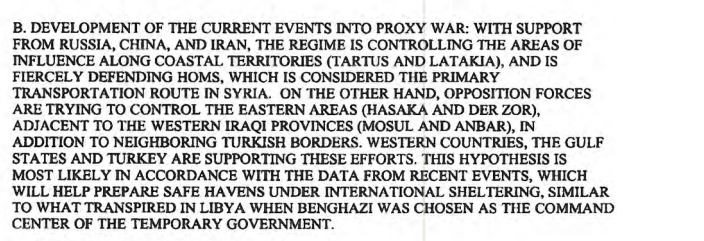
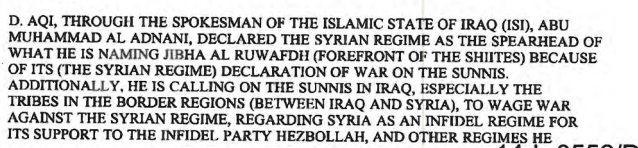
Who are the opposition you ask? Well from the media we know that the West are supporting the Free Syrian Army and anyone linked to the Syrian National Coalition however it clearly denotes in this document that without the work of AQI (now known as ISIS), they could not play a pivotal role in uniting the Sunni Muslims under the sectarian card to fight the dissenters who they call the Jibha al-Ruwafidh (Forefront of the Shiites)


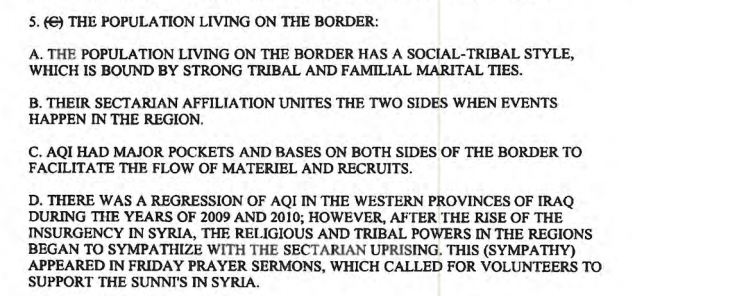
It goes on to say that the flow of fighters and ammunition comes through the border between Iraq/Syria and it depends on AQI (now ISIS) as it has major pockets and bases on both sides. This spells out that without ISIS, the West could not support the opposition against Assad or keep the equilibrium going to destroy the infrastructure, people and livelihoods of Syria and Iraq.


It mentions that the future holds a safe haven for the Syrian regime, i.e. Assad and the Alawi's. This is reaffirmed by the recent plans drawn up by RAND and the Brookings Institute explaining the greater plan for a federalized Syria into three regions.


Now the key for the next point is in the wording. The U.S. have maintained that they want a peaceful solution to the Syrian crises and they'll take every opportunity to demean Russia's actions in Syria, but make a note of the wording on this next point in the document.


Did you spot it?

Try again....


That's right the development of a proxy war WITH SUPPORT from Russia, China and Iran. This proxy war is undoubtedly and undeniably a proxy war that doesn't see the Americans, Russians, Chinese or even Europeans losing their lives. It is the MUSLIMS who are being targeted and it is the Muslims who are losing their lives for a war that is not even their own.

The report finally goes onto 'prophesies' if I may use that term loosely, that the opposition which the West support will use Iraq as a launch pad and safe haven for the Salafists, i.e. ISIS - whom they fully support and whom without the equilibrium could not be sustained without marring their own faces and sending in their own troops as was the case in the Iraq war.

And just to top all of this off they kindly mention that 'if the situation unravels' in the West's favour there is a 'possibility of establishing a declared or undeclared salafist principality' - and what is the form of interpretation of Islam ISIS are following? ... how convenient.. it's Salafist.


Finally it decides to redact the part about facilitating the terrorist organisations into entering the Iraqi arena.


If this section were to take the angle that other powers out of America's control were facilitating the terrorist elements to enter the Iraqi arena then it surely wouldn't have redacted this part out. It leads one to believe that this section was in fact talking about how the West can renew the facilitation of rounding up the Jihadi organisations from around the world and push them into Iraq. Exactly what ISIS are doing today with many groups pledging their allegiances to them and flocking to join their ranks.

Now if you still believe ISIS are not their to serve the agenda of the West, then you're truly and utterly naive. This is a sectarian war headed by the U.S with its allies Russia, Iran and China to bring the Muslims to their knees and destroy whatever they have left in their capability, i.e. nuclear, manpower or resources and ultimately their religion that binds them.

Thank you for reading this, share this widely with others.

Jazakamullah Khairan

Wednesday, 3 February 2016

The Three Types of Sectarianism - Washington Institute

A recent article published by the Washington Institute interestingly separates sectarianism into three types.

1) Institutionalized Sectarianism
2) Incidental Sectarianism
3) Exploitative Sectarianism

Institutionalized Sectarianism
"Some groups and states have integrated sectarian themes into the very fabric of their political, cultural, and educational systems. Sectarianism, in other words, has been institutionalized. "
Institutionalized Sectarianism is by far the most dangerous and most difficult form of sectarianism to counter. Examples of this include the likes of Saudi Arabia's Wahhabism and Iran's 'Governance of the Jurists', meaning a regime overseen by scholars. The article goes on to say that this is something ISIS is also seeking to achieve.

Incidental Sectarianism
"...as its name implies, does not involve a deliberate effort to implement a sectarian agenda. Sectarianism does not play a central role in a state or group's objectives, even if there are overtones of it."
Incidental Sectarianism is a form of sectarianism that is evident in conflicts even if that was not the reason for the conflict. The Syrian civil war is an example of this whereby the struggle is not to eradicate the Alawite, but rather the Alawi regime from leadership - but at the same time the opposition uses sectarianism to bolster their ranks. 

Exploitative Sectarianism
"Finally, there is exploitative sectarianism, a category that characterizes the tactics and nature of many of the most violent actors in the region."
The article suggests that most of the larger Jihadi organisations today exploit sectarianism to recruit and to achieve political goals however one could argue that the West not only exploit sectarianism but help in institutionalizing it for their own gains in the Middle East. 


Wednesday, 23 December 2015

RAND's peace plan for Syria

RAND Report: http://www.rand.org/content/dam/rand/pubs/perspectives/PE100/PE182/RAND_PE182.pdf

It is important to know that the RAND corporation are no ordinary think-tank. They are one of the leading think-tanks in America that have shaped policy and decision making at the highest level. This is why any analysis that come out of RAND, you can be sure that it is the direction the politicians will take in America.

This recent report by RAND regarding the peace plan for Syria agrees with much of the Brooking's Institutions report on deconstructing Syria towards a regionalized strategy.

The report starts off by recognising the two paths that can be taken in Syria, them being:

  1. Concentrate on brokering a comprehensive political arrangement among the warring Syrian parties and their external sponsors, including the reform of state institutions, the formation of a new government, and a plan for elections, accompanied by a ceasefire and the beginning of a process of reconstruction.
  2. The second approach would be to secure agreement to an immediate ceasefire, which would be followed by further negotiations on the shape of a reconstituted Syrian state and government.

We can see that the West are currently aiming for the first path by gathering the opposition to come to an agreement. However whether or not Assad stays or leaves is the main sticking point for most of the warring factions - something that Russia also wish to have a say in. 

RAND suggest that path one is unrealistic now that sectarianism is as rife as ever. 
"pitting the regime against the opposition, Shi’a against Sunni, Arab against Kurd, and moderate against extremist. It has attracted tens of thousands of foreign fighters from Europe, North America, and Africa; exacerbated geopolitical rivalries among Saudi Arabia, Iran, Russia, the United States, and others; and drawn in the armed forces of nearly a dozen external states. There may have been a time, early on, when it could be argued that the benefits of overthrowing Assad would be worth the human, strategic, political, and economic costs of achieving that goal, but that time has long past. At this point, whether President Assad stays or goes in the near term should be regarded as a matter of pure expediency"

Whereas the second path seems to be more achievable according to both RAND and the Brooking's Institute. The most telling point of this report is the acknowledgement of three safe zones for Syria. RAND writes:

"Were the fighting to be halted on the basis of the territory currently held, Syria would find itself divided into roughly four zones—one controlled by the government; one controlled by the Kurds; one controlled by diverse elements of the Sunni opposition; and one controlled largely by the Islamic State of Iraq and Syria (ISIS).1 As ISIS has no foreign sponsors, is largely immune to external influence, and is certain to reject any ceasefire, Syria would effectively be divided into three “safe” zones in which the parties agreed to stop fighting, and one zone in which all other parties would be free to wage war on ISIS."

 RAND's proposal acknowledges three difficult realities.

  1. The first is that four years of fighting and more than a quarter million dead have left Syria intensely divided by sect and ethnicity. It should be a goal to mitigate those divisions in the long run, but they must be acknowledged in the short run.
  2. Second, ousting the current regime by building up the military power of the opposition—the basic approach of the United States and its partners for the past four years—is unlikely to succeed. Russia and Iran have proven so committed to the regime’s preservation that escalation of the conflict has not led to Assad’s capitulation, but rather a significant counter-escalation, more killing and refugees, and radicalization of the opposition.
  3. Third, the current battle lines on the ground, while hardly ideal, would have to be the fundamental basis of any armistice. Limited territorial swaps may be necessary to facilitate the disengagement of combatants and assist in ceasefire implementation.

It goes on to state that the war in Syria has ruined the intermixing of  ethnicities and sects within Syria, thus forming regions based on them or creating lines in the sand, what some would call Sykes-Picot Part 2.

 "Like most countries in the Middle East, Syria’s ethno-sectarian breakdown is far from clean. Syria’s communities have historically intermixed, so there is no such thing as a solid stretch of land inhabited by a single community. In addition, Sunni Arabs constitute more than 60 percent of the country’s total population. They are present throughout the country, comprise A ceasefire may not be a sufficient condition for an eventual political settlement, but it is likely to be a necessary one. 3 a majority even in regime-held areas, and in many cases remain loyal to the Assad regime.4 These important caveats aside, Syria’s longstanding ethnosectarian map does reflect regional groupings, which have been consolidated by internal displacement"
Without the war in Syria it would have never been possible to split Syria up on ethnic and sectarian lines. One could call this the sickest method of separating the Ummah of Muhammad (pbuh).


The map above shows the clear zones that RAND are suggesting in their proposal for Syria. In the full report you will find more maps relating to sects within Syria before and after the war. 

It is also interesting to note how RAND suggest each of these players are backed by international support to secure its own interests.

Thus, Russia and Iran would guarantee the regime’s adherence; the United States would guarantee Kurdish adherence; and Turkey and Jordan would guarantee the Sunni opposition’s adherence. All external parties would collaborate to dislodge ISIS. 
However I do believe that the final point about all external parties collaborating to defeat ISIS is only mentioned due to the fact ISIS have been used as a pretext for all this change in the Muslim world and also to contain the Muslims from seeking an alternative system. It will be interesting to see how long ISIS remain after the Syria end game is played out. They will either cease to exist or kept like Al Qaeda as a pretext into other parts of the Muslim world where the West require change. So far they have become the golden egg for the West and so easily allowed them to dictate the situation for the rest of the world under the guise of "terrorism".

It goes on to mention that it could become somewhat similar to Lebanon's sectarian power sharing model including the international oversight on the Bosnia model using U.N forces to implement ceasefire and support. If this is the case, the Muslims should look back at what happened to the Bosnian Muslims as the Serbs slaughtered them in U.N's presence. It would be a disaster to allow them to "protect" the Muslims.
"International oversight of the ceasefire and support for the political process would be undertaken by a Peace Implementation Council, on the Bosnia model, made up of the above-mentioned states plus others ready to contribute significantly. "
It clearly admits that support for Al Nusra and other groups currently receive support and will stop receiving it once the above actions have been taken.

"It would have to be clear to all groups that external support will be cut off for groups that violate the ceasefire."
 In conclusion it is clear to see that this second path is on its way already as Russia have now become a key player in the Syria end game, and was needed in order to support Assad in a alawi region and be their main guarantor.

Kam Kashem

Friday, 18 December 2015

The "Islamic" Military Alliance by Abu Usaid

Observers of the research released by the US strategic centres can perceive clearly the policies America pursues in our lands. They have determined that in order to prevent the rise of an "Islamic State", or in case the current regimes failed, the US should move away from the "soft power" and the "idealist approach"  and resort to "hard power" and "realpolitik". As for the "Jihadi" movements, it is imperative to deal with them according to the following steps: they should be contained and recruited; and if the containment failed, it is imperative to provide their opponents with "Indirect Military Support" then resort to "Indirect Military Intervention" against them and then resort to "Keeping Them Out."  


If the Muslims wished to engage in a struggle against their enemies in order to achieve liberation and revival, they ought to perceive the doctrine of the enemies, their plans and their adopted styles and means of execution. Capitalism is the doctrine upon which Western thought is built and expediency is the viewpoint towards life and the criterion that determines their behaviour, and colonialism, in all its forms, is the method through which they acquire the benefits, repel the detriments and achieve their interests. Their strategy towards the Muslims involves eroding the political feature of Islam from the life of the Muslims and confining it to the rituals which does not influence ruling matters, especially in respect of the Ummah's relationship with other nations and peoples. Once the Ummah has accepted the doctrine of separating religion from life, even with her own acknowledgment and approval, her mentality will be hijacked, her volition will be forfeited  and her intellectual compass will be deviated; she will then think like her enemies do, accept what they decide and head to wherever they want. As for the styles and means, these are numerous and they vary according to the conditions and situations and they include direct and indirect "hard power" as we mentioned earlier, or "soft power" which includes the diplomatic activities and the generating of influence through agents, rulers, armies, media, judiciary, scholars and movements.   


These issues are among the most important political concepts the Muslims should acquire in order to perceive the political activities of their enemies. Hence, we may through such activities pass judgement on the political situation in the "Arab Spring" countries. In Syria, the American political activities towards the armed movements are still at the stage of recruiting some of them and attempting to contain the others; all the movements are recruited to fight the Syrian regime with the backing of America's agents in the Gulf and Turkey. However, some of the movements are yet to be contained and some of their members are yet to be tamed into accepting the post-Assad phase.


Hence, the categorising process took place at the Riyadh conference in order to implement the strategies of "Containment", "Indirect Military Support", "Indirect Military Intervention" and "Keeping Them Out". The decision to establish the "Islamic Military Alliance" to combat terror after the Riyadh conference has come to epitomise the American strategy of "Indirect Military Intervention" to isolate and keep  the opponents out. The task of this alliance will include areas in Syria, Iraq and Libya. As for Yemen, the situation is different on the ground since al-Houthi group is undertaking the role of servant for the American plan to fragment Yemen, while the Saudi military machine works towards maintaining an equilibrium among the Yemeni warring factions and preventing the fireball from reaching Saudi Arabia. If the alliance were compelled to intervene in Yemen against the Houthis, it would merely be to tame them and keep them under control rather than to destroy them.
Establishing  a military alliance with an "Islamic" flavour will undoubtedly justify the rejection of the undesirable foreign military interventions in the future, such as the Russian intervention. America managed to drag Russia into the Syrian quagmire and implicate her with the Muslims, so that her belligerence may turn into anger and resentment among the Islamic constituent of 25 million in Russia, thus weakening the coherence of the Russian Federation and threatening its existence.


The "Islamic" military alliance is also set to end or scale down the military services offered by Europe who always seeks a slice of the oil pie in return; France and Britain had demanded a third of the oil and building contracts before the military operation against the Gaddafi regime in Libya started. Those who think that the prospective  "Islamic" alliance will be in the interest of the Muslims are woolgathering because most of the Arab states have open and covert ties and treaties with the "Israeli" entity and are involved in military alliances with the world powers which means that such an alliance would target the Muslims rather than their enemies.

The "Islamic" alliance aims also to sidestep the Russian military campaign that has affected the efficacy of the aerial military campaign led by the US. There may also be an American plan to curtail the role of Daesh in Syria and Iraq through the "Islamic" alliance in order to nullify the pretexts of the Russian military campaign upon which Putin is relying to sustain his popularity inside Russia. Furthermore, the intervention of the alliance would dampen the aspirations of Iran in Syria and Iraq and prevent Hezbollah from achieving political gains to consolidate its domestic influence and increase its stake in the Lebanese regime.


"And if they had intended to march out, certainly, they would have made some preparation for it, but Allah was averse to their being sent forth, so He made them lag behind, and it was said (to them), "Sit you among those who sit (at home)." [9-46]


"Had they marched out with you, they would have added to you nothing except disorder, and they would have hurried about in your midst (spreading corruption) and sowing sedition among you, and there are some among you who would have listened to them. And Allah is the All-Knower of the evildoers." [9-47]


"Say: "Nothing shall ever happen to us except what Allah has ordained for us. He is our Lord And in Allah let the believers put their trust." [9-51]
"They swear by Allah that they are truly of you while they are not of you, but they are a people who are afraid." [9-56]

16 December 2015
Abu Usaid


Thursday, 17 December 2015

The Jihadis - A Pawn for the West

A recent confab took place in Saudi Arabia which included "opposition" leaders from the factions fighting in Syria, namely Ahrar al-Sham and Jaysh al-Islam, both affiliated to Al-Nusra Front who are a designated foreign terrorist organisation according to America - Saudi's greatest ally.

After great strides made in Syria against Assad it was about time that they'd be put back into their place by America's "enemy" Russia - but what has this achieved?

1) Allows the West to negotiate with the "rebels" temporarily until a deal is struck
a) Then wipes them out after claiming they have sided with Al Qaeda - similar to how most of the Jihadi factions were used and abused in the past after they've aided in the West's plans.

2) It forces the many factions on the ground to compromise the political solution for Syria
a) Giving up the Sharia in return for a liberal democratic form of governance, contrary to what most of the factions call for.

3) Preserves the face of America as it is the 'Russian Bear' that is delivering the blows while America are the peacemakers that will inevitably be the leader in coming to a political solution. 
a) At the same time it weakens the Russians, pulling them in to a battle that they'll never be able to come out of without a dent, both domestically and internationally. 
b) Creates a wedge between Russia and Turkey that will affect Russia moreso than Turkey due to its high dependency on trade after the sanctions with the European states. 


As for the Jihadi's, well... better luck next time. Sincere intentions, but the wrong method. However the sympathy shouldn't be with them but rather the millions of innocent Muslims that will die due to their carelessness and inability to stick to the Prophetic method of bringing Islam back as a State. 

May Allah make us one of those who persevere in the correct manner and in the manner that won't be detrimental to the Ummah of Muhammad (sallalahu alayhi wasallam)

Kam Kashem


Where are the Muslim Brotherhood Taking the Ummah of Mohammed (saw)? - By Abu Usaid

The Muslim Brotherhood have sold Syria for a trifling worldly gain after they had forsaken Islam in Tunisia, Libya, Egypt, Yemen and Sudan. For a Muslim to sacrifice his wealth and his life to establish a state in which he is commanded to disbelieve is beyond comprehension. "They wish to refer legislation to Taghut, while they were commanded to reject it; and Satan wishes to lead them far astray." [4-60]
The deputy leader of the Muslim Brotherhood of Syria, Mohammad Farouk Tayfour, who attended the Riyadh meeting yesterday, said in an exclusive interview with al-Arabiya.net: "The Muslim Brotherhood in Syria  have never viewed the revolution as a secular or religious issue." He added: "The revolution is a nationalist issue that excludes no one." He also confirmed the openness of the Muslim Brotherhood in Syria to dealing with the West and the US by saying: "We have our special method and we have a similar vision to that of the Muslim Brotherhood in Tunisia and the Congregation for Reform in Yemen." In respect of the notion of Khilafah and the group's opinion on it in Syria, he explained that "the specifics and the conclusive evidences on the issue of ruling in Islam are limited." And on the Muslim Brotherhood's relationship with al-Nusrah Front, he said: "We have made great strides in terms of deepening the principle of centrism and moderation but we are yet to reach an agreement on their willingness to sever their ties with al-Qaeda." 
No one disputes the fact that the notion of "nationalism", from which Dr Tayfour is departing, is built upon the doctrine of separating religion from life and it removes the barriers and boundaries between Islam and Kufr; otherwise how could one reconcile between the exigencies of nationalism which legitimises the accession of a citizen to power irrespective of his religion and the prohibition of a non-Muslim assuming power? Allah (swt) says:"And never will Allah give the unbelievers a way over the believers." [4-141] Ibnul-Arabi said: "Indeed Allah (swt) does not allow the Kuffar a way over the believers in Shari'ah; and if it were to materialise, it would be contrary to Shari'ah." Allah (swt) says: "O you who believe, obey Allah and obey the Messenger and those in authority from among you." [4-59] This proves in a conclusive manner that authority belongs to the Muslims because the address in the ayah is to the Muslims and Allah's (swt) saying "from among you" denotes that the supreme authority belongs exclusively to the Muslims; Allah (swt) has also forbidden us from obeying the Kuffar by saying:"O you who believe if you pay heed to those who are bent on denying the truth, they will cause you to turn back on your heels and you will be the losers." [3-149]

Another ayah denoting the prohibition of the Kafir's authority over the Muslim is Allah's (swt) saying: "O you who believe do not take the Kuffar as allies in preference to the believers". [4-144] Al-Qurtubi said about this: "This means do not take as your confidential and close staff from among them." It is also reported on the authority of Ubadah Ibnul-Samit that he said: "The Prophet (ﷺ) called us and we gave him the Pledge of allegiance for Islam..... to be obedient to the ruler and give him his right even if he did not give us our right, and not to fight against him unless we noticed him having open Kufr (disbelief) for which we would have a proof with us from Allah." Qadi Ayyadh said: "If he were to commit Kufr or to change the Shari'ah or concoct an innovation, he would deviate from the authority and his obedience would be nullified; and the Muslims would have to stand up to him and remove him, and establish a fair Imam if they could; and if this were to only occur to a group, they ought to undertake the removal of the Kafir."
Hence, how does the concept of nationalism and the criterion of citizenship that Tayfour is calling for tally with the Islamic system he has been commanded to establish?
These evidences are sufficient to demolish the foundation upon which the thought of Dr Tayfour is built and they are binding on every member and supporter of the Muslim Brotherhood movement to return to the Book of Allah (swt) and act according to it before calling the masses to it. The movement should refrain from deceiving people with the slogan of "Allah is our aspiration and the Qur'an is our constitution" because they stand the farthest from it; and Allah (swt) says: "O you who believe why do you say one thing and do another? Most loathsome in the sight of Allah that you say what you do not do." [61-2,3] 
If the decision maker in the Syrian file has assigned to the Muslim Brotherhood the task of dissuading al-Nusrah Front from pursuing armed struggle and of luring them into the camp of "moderation and centrism" instead, they should then refrain from trumpeting the slogan of "Jihad is our way" and tinkering with the Ummah's objective. 
Dr Tayfour says the Muslim Brotherhood has never viewed the revolution as either a "secular or a religious" issue; so what is their issue then? Does he want to justify his acceptance of the state's secularity or does he want us to understand that dealing with the issue through religion would cast a shadow over the victory that descends from the White House? If the plane of the struggle against the regime were not an issue of Islam and Kufr, how would we then describe the presence of the Muslim Brotherhood in the revolution?  Was it a cheap functional reaction to the American exigencies to shape the Middle East? Or was it an exploitation of Islam to solidify secularism and secure its embracing among the masses? Or was it meant to deviate the direction of the Muslims and curtail their aspiration to achieve liberation and revival?
The statements of Dr Tayfour about the conclusive evidences on the legitimate Khilafah being limited indicates very clearly that the Muslim Brotherhood have washed their hands of the Ummah's central issue and submitted to the volition of the colonialist Kafir West regarding the regime they intend to establish on the ruins of Bashar Assad's regime. Tayfour is attempting to belittle the issue of the Khilafah and propagate the secularist state to the masses in Syria under the pretext that the "conclusive" evidences for al-Khilafah are limited. By disowning the Khilafah system, Tayfour is also attempting to provide support for the outcome of the Riyadh meeting and to dissipate the Western fears of the Islamic trait sported by the "opposition" movements, thus aping the American viewpoint towards Islam. He is also attempting to nullify the Russian arguments and justifications for rejecting the "Islamic" movements and present his group to the West as being a match to their foster child Erdoğan as a guardian of secularism.  
Hence, the call of the Muslim Brotherhood through Dr Tayfour contradicts the conclusive texts of the Qur'an and the Sunnah, violates the volition of the Muslims, squanders their dignity and their sacrifices and gives a way to the Kuffar over the Muslims. No sincere Muslim should accept or support such a call.
"O you who believe do not betray Allah and the Messenger and do not knowingly betray the trust that has been reposed in you." [8-27]
13 December 2015  
by Abu Usaid

Monday, 9 November 2015

Putin’s aspirations lead Russia towards disaster

The Russian military operations in Syria still raise many questions regarding the objectives, limits, duration and chances of achieving their goal of reinstalling Moscow as a dominant world power.
Russia’s conflict with the West came about as a result of the deployment of a US missile shield in Europe, Washington’s update of its tactical nuclear weapons and NATO’s advancement towards its western border. After Putin’s enthusiastic efforts to achieve closer integration with Europe and the West in general during his first three years in power, he changed direction suddenly and worked towards building a strong state. His strategy was based on two axes: Russia’s near neighbours and those further away. He has sought to regain control of what he considers to be Russian territory annexed by neighbouring countries and to restore Moscow’s control in the former Soviet Union countries under the pretext of protecting ethnic Russians and Russian speakers. The goal behind the second axis is to limit America’s global role and influence and to allow Russia to play a prominent role in international decision-making.
These efforts include working towards Russia regaining its position in an international system based on bipolarity alongside the US. In order to achieve this, Putin launched economic and military programmes to regain balance within Russia and increase its ability to take regional and international action to impose its presence and boost its prestige.
Hence, he worked on strengthening Russia’s military presence in the former Soviet Union by means of military bases and strengthening the Collective Security Treaty Organisation. He also called for the formation of a customs union to include the former Soviet Union countries and for the adoption of a military doctrine based on reinforcing missile defences and the development of carrying systems for nuclear warheads, such as missiles, submarines and strategic bombs. Conventional weapons have also been modernised, with an operational command and naval fleet based permanently in the Mediterranean. In addition, a network of military bases has been built to house air defence forces, rapid reaction brigades and navy vessels deployed above the Arctic Circle.
Having adopted brinkmanship as a tactic, Putin is also doing a lot of muscle-flexing, and is hinting at the possibility of the outbreak of a world war. Russia’s spending on arms now exceeds 9 per cent of GDP as the president deploys aircraft and ships around the world.
The outbreak of the Arab Spring revolutions sparked additional disputes between Russia and the West, especially after the latter’s intervention in Libya, depriving Russia of its piece of the cake, as well as threatening its interests in Syria. This pushed Russia into engaging in an indirect confrontation with the West by supporting the Syrian regime in its fight against the revolution and protecting the regime politically by using its veto at the UN on four occasions. Moscow has supplied Damascus with weapons, money and military experts, and has coordinated with Iran to prevent the Assad regime from collapsing under too much political and military pressure.
The moves by the European Union and NATO to allow Ukraine to join them irked Russia, due to Moscow’s imagining of a Eurasian Union. This has escalated the tension in the region, with Russia pushing ethnic Russians and Russian speakers in eastern Ukraine to hold a referendum and declare the establishment of the “Donetsk and Lugansk People's Republic”.
Russia has exploited the cool relations between the US a number of its allies, such as the Arab Gulf states on the back of the Iranian nuclear deal, and Egypt on the back of Washington’s reservations over political oppression, the use of excessive force against the Muslim Brotherhood and the politicisation of the judiciary. Putin has used this to make trade, arms and investment deals as well as contracts to build nuclear power plants, all in the hope of forcing Washington to deal with Russia as another world power.
This was achieved and Russia is now living with inflation and deflation due to Western economic sanctions and the fall in oil and gas prices. Some Russian observers predict the fall of oil prices to $40 or even $20 per barrel. It is worth noting that for every $1 drop per barrel of oil, Russia loses $2.5 billion.
We must not forget that a fifth of the external debt of $700 billion and the debt accumulated by Russian companies, which amounts to $500 billion, must be repaid this year; nor that capital ranging from $100 and $200 billion was taken out of Russia in 2014. An increase in oil and gas supply after recent large discoveries will reform the market and impose a new balance in which Russia’s share will drop; gas and oil represent about 74 per cent of Russian exports and its revenues make up 50 per cent of the state’s resources, both of which are the main source of hard currency. Western business investments are likely to be withdrawn; indeed, 87 companies have already liquidated or reduced their presence in Russia. This has caused a fall in the value of the rouble; the exchange rate against the dollar has fallen by 20 per cent. It is worth noting that at the beginning of 2014, $1 was equal to around 33 roubles; it is now 66 roubles. This has led to a 30 per cent increase in the price of basic foodstuffs and the decline of growth to below zero per cent.
Despite the fact that Russia’s revenues from oil and its by-products, and natural gas, reached about $3.2 trillion between 2000 and 2013, it did not result in the modernisation of the Russian economy, its diversification or ending its dependence on the export of raw materials and the import of advanced technology. It was growth without development. This caused a contradiction in Russia’s structure between the military and economic forces; the label attached to the Soviet Union of being a giant with two legs, one powerful (military) and the other weak (economy), also applies to the Russian Federation.
Which brings us to American historian Paul Kennedy’s equation regarding the rise and fall of great powers: a strong economy that finances an army deployed abroad and a lack of financial ability to spend on overseas military operations both put great powers on the path towards failure. The continuation of the Russian-Western conflict and Moscow’s military involvement in Ukraine and Syria, as well as the possibility of its involvement in Iraq, will lead to the exhaustion of Russia's money supply and push it to the brink of bankruptcy.
This worries Russian citizens and has widened the gap between them and their leadership. The situation does not align with the doctrine and principles of the populist government and its sole hero Vladimir Putin, which depends on the enthusiasm of the Russian people and their ardent nationalism in order to mobilise behind him and protect him from their anger. He does so by promoting his description of the situation that the Russians have found themselves in as part of a Western conspiracy.
The Russian military intervention in Syria is based on opportunities and risks. Such opportunities include reinforcing Russia’s influence, limiting Washington’s ability to take unilateral action in the Middle East and other parts of the world, and forcing the US to negotiate with Moscow on regional and international issues, thus recognising Russia as an equal partner in global decision-making. However, it involves greater risks, as Washington does not accept Moscow as an equal or an influential player in the international arena. Indeed, it treats it like a junior partner there to serve the interests of the stronger party, according to the intersection theory spoken about by Zbigniew Brzezinski, the former US National Security Advisor in his book Between Two Ages: America's Role in the Technetronic Era.
Many analyses have predicted that domestic criticism will increase when soldiers start going home from Syria in body bags. Despite the fact that Russia is relying on air strikes to wear down the opposition in preparation for a ground attack by the Assad regime, its Iranian allies and the militias associated with Iran, in order to regain control of the territories lost in recent months and keep the opposition forces away from the coast, where the Russian naval base is located, this tactic is facing many obstacles. The first of these is the lack of effectiveness of the air strike in achieving decisive results in the asymmetric war. Another obstacle is the fact that Russia is linked to a weak ally — the regime — making it more difficult and placing a heavy burden on Moscow.
If the Syrian opposition forces succeed in avoiding Russia’s air strikes, and containing them, and then respond with powerful blows to the regime and its allies, they would have stopped the “tsar” from achieving quick results, such as reinforcing the regime’s position and pressuring the West to accept a trade-off. They would have a tactical victory in light of the unbalanced nature of the conflict and in accordance with the rule that, “The army is defeated when it is not victorious, while the resistance is victorious when it is not defeated.”
This could put the Russian leadership in a confrontation with public opinion at home, which is still suffering from Afghanistan syndrome; the people have a deep-seated fear of slipping in a foreign war.
Pushing Russia to withdraw from Syria without any positive results will reflect negatively on the “heroic” image of Putin and will lead to a decline in Moscow’s international role. That would push it back and force it to accept Washington’s conditions for a resolution of the crisis in Syria, the first of which is a new leadership in Damascus.
Russia’s involvement in such a war as Syria’s involves great risks for a country that is suffering from economic problems and is on the verge of bankruptcy, unable to pay its debts. Add to that the fact that it is suffering from social problems and existential concerns due to the demographic and religious structure of society, in order to achieve a near-impossible goal — a return to a world of bipolarity — and it is clear that Russia is reflecting a number of disparities in its strategic outlook.
Translated from Al Jazeera net, 4 November, 2015.

Monday, 19 October 2015

Only the Islamic Shield can Withstand the Onslaught by the Kuffar

It is patent to every observer that the Islamic Ummah is enduring her darkest days and her most awkward conditions. All and sundry have ganged up on her. Plots and conspiracies have been concocted to keep the Ummah incapable of reversing her situation and assuming her own affairs. After they had engrossed her for decades with the issue of Palestine, they embroiled her again for decades with the issue of Iraq, the "war on terror" and the Greater Middle East Initiative. All these engrossments, or rather all these conspiracies, have been designed to alienate the Ummah from her central issue and keep her a hostage to the vicious circle of a struggle with the Kafir West. Yet, this struggle is unbalanced since the West looks upon us as one single Ummah but deals with us as divided segments and endeavours to corroborate the separation and the fragmentation by entrenching the animosity among us whenever the opportunity arises.
Our main issue is neither Palestine nor Iraq or Syria or Egypt. These are vital issues that emanate from the central issue, namely establishing Islam in the realm of life. Any other effort exhausted towards other than this issue would sidetrack the Muslims and perpetuate the dominion of the Kuffar over their lands.  
As for the vital issues that stem from the central issue, such as the issues of Syria, Iraq and Palestine, the only fruitful effort towards settling these issues is to work in a country in control of its own security and free from the military presence of the Kuffar. This country should possess the faculties of a state so that it may be the nucleus of the Islamic state, through assiduous and effective work to fuse the masses with Islam in its quality as a rational Aqeedah from which a system emanates to regulate all life's affairs. Work should be concentrated in this country to prepare its people and their forces to support Islam and establish the Islamic State which will in turn work towards bringing the rest of the Islamic lands under its wing and towards liberating the occupied lands from the occupiers by expelling their forces.
As for the stance of the Muslim in Syria in particular, they should perceive that the criminal regime is conducting a war in which the Muslims are killing each other, their country is being destroyed and their faculties depleted; this dirty war is overseen by a malicious enemy, namely the Kafir West aided by Russia. They keep plotting and planning against the Muslims to perpetuate the crisis and weaken the regime and its opponents further in order to impose their own agenda on them and initiate a roadmap for a secular state to replace the secular Baath regime that oppresses the Muslims in Syria. If the Muslim perceived this reality, he would perceive his stance vis-à-vis this war: he should neither lean towards a secular Kafir Baath regime that kills the Muslims and sows the seeds of strife amongst them, nor should he side with an opposition that blatantly admits its relationship with the devious enemies of this Ummah and urges them to intervene militarily and supply it with sophisticated weapons. This does not mean the Muslim should remain confused about what course of action to pursue; he should rather work towards ending the bloodshed to the best of his ability. He should defend himself, his family and his property should anyone or any group transgresses his inviolabilities. If he cannot defend them, he should seek a safe haven if he could. His raison d'être should remain Islam. He should work towards its return by establishing the Islamic State. This is what is required from a Shari'ah perspective.   


Sawt-ul-Ummah - Issue 16

Tuesday, 6 October 2015

The confederal and autonomous zones of Syria - Master Plan by the U.S.

In June 2015 Brookings Institution released a  paper titled Deconstructing Syria: Towards a regionalized strategy for a confederal country that detailed the policy that the U.S. should take in solving the Syrian crises that was unsurprisingly fomented by them. In this short post I will look at some of the key actions that was suggested and see whether they are being played out today.

In the introduction to the paper it mentions the overall strategy being:

The new approach would seek to break the problem down in a number of localized components of the country, pursuing regional stopgap solutions while envisioning ultimately a more confederal Syria made up of autonomous zones rather than being ruled by a strong central government. It also proposes a path to an intensified train and equip program. Once that program had generated a critical mass of fighters in training locations abroad, it would move to a next stage. Coupled with a U.S. willingness, in collaboration with regional partners, to help defend local safe areas using American airpower as well as special forces support once circumstances are conducive, the Syrian opposition fighters would then establish safe zones in Syria that they would seek to expand and solidify.

At the time, this sort of solution seemed far fetched and ambitious, but we can see today that with the help of Russia, and "U.S. willingness" to this, they can indeed target those factions unfavourable to a permanent solution for Syria after Assad is deposed. It also serves in segregating the Islamic world further by smaller nations already divided on lines in the sand, to a more aggressive sectarian division that is not only based on culture, colour or language but on fundamental religious values and war.

The paper goes on to mention how the confederal arrangement for Syria could be merged using Kurdish region and Jordan:

The strategy would begin by establishing one or two zones in relatively promising locations, such as the Kurdish northeast and perhaps in the country’s south near Jordan, to see how well the concept could work and how fast momentum could be built up. Over time, more might be created, if possible. Ultimately, and ideally, some of the safe zones might merge together as key elements in a future confederal arrangement for the Syrian state.

This may not be apparent right now but certainly is leading up to such a scenario after reports from the Institute of Study of War (ISW).

It is clear that without the support of Turkey and Jordan, these autonomous regions cannot be sustained and therefore they both will have a big role to play in dividing Syria, the report suggests:

Creation of these sanctuaries would produce autonomous zones that would never again have to face the prospect of rule by either Assad or ISIL. They would also constitute areas where humanitarian relief could be supplied, schools reopened, and larger opposition fighting forces recruited, trained, and based. U.N. agencies and NGOs would help in the effort to the extent possible, focusing on health, education, and basic economic recovery in the first instance. Governing councils would be formed, more likely by appointment than election, to help international agencies make decisions on key matters relevant to rudimentary governance. Regardless of details, relief could certainly be provided far more effectively than is the case today. At least one such area should be contiguous to Jordan and one to Turkey, and be created in cooperation with Amman and Ankara. These locations would allow secure transportation lines for humanitarian as well as military supplies. They would also provide bases from which to attack ISIL in its strongholds, a mission that western forces could carry out in conjunction with local allies. 

In the end, the Alawites will be given a zone whereby they can control, leaving Russia and Iran a part of the cake so that they take something away from this end-game. 

The ultimate end-game for these zones would not have to be determined in advance. The interim goal might be a confederal Syria, with several highly autonomous zones. One of those zones might be for Alawites. But none could be for ISIL, al-Nusra, or Assad and his inner circle

The report interestingly goes on to say what Russia and Iran get from this plan of action:

This strategy might soften the opposition to the basic approach by Iran and Russia as well—perhaps reducing their inclination to escalate support for Assad and also possibly even enlisting them in a future negotiated deal about Syria’s ultimate future. Indeed, the strategy strikes a balance in its approach to Iran and Russia. It would grant neither a major role. But it would seek to mitigate the risks of escalating rivalry with them by holding out political hope and the prospect of an autonomous region for Alawites (even those previously associated with the Assad regime, as long as they were not from his inner circle). This approach may appeal even more to Moscow and Teheran to the extent that battlefield dynamics go clearly against Assad in a sustained way, as they have been already in the spring of 2015. 4 Damascus and Moscow would be much more likely to support a confederal Syria to the extent they believe that the alternative had probably become the complete overthrow of Assad and his government—and the elimination of meaningful Alawite influence in a future government—or, in a best case, protracted civil war of indefinite duration. 

Is this not the case today? The invisible handshake between America and Russia clearly states that there is an agreement in place. Iran has also become a major player in the region.

It's worth reading the full PDF here: http://www.brookings.edu/~/media/research/files/papers/2015/06/23-syria-strategy-ohanlon/23syriastrategyohanlon.pdf